Smart Temperature and Humidity Control for Food Preservation: Sensors, Plugs, and Deadband Logic
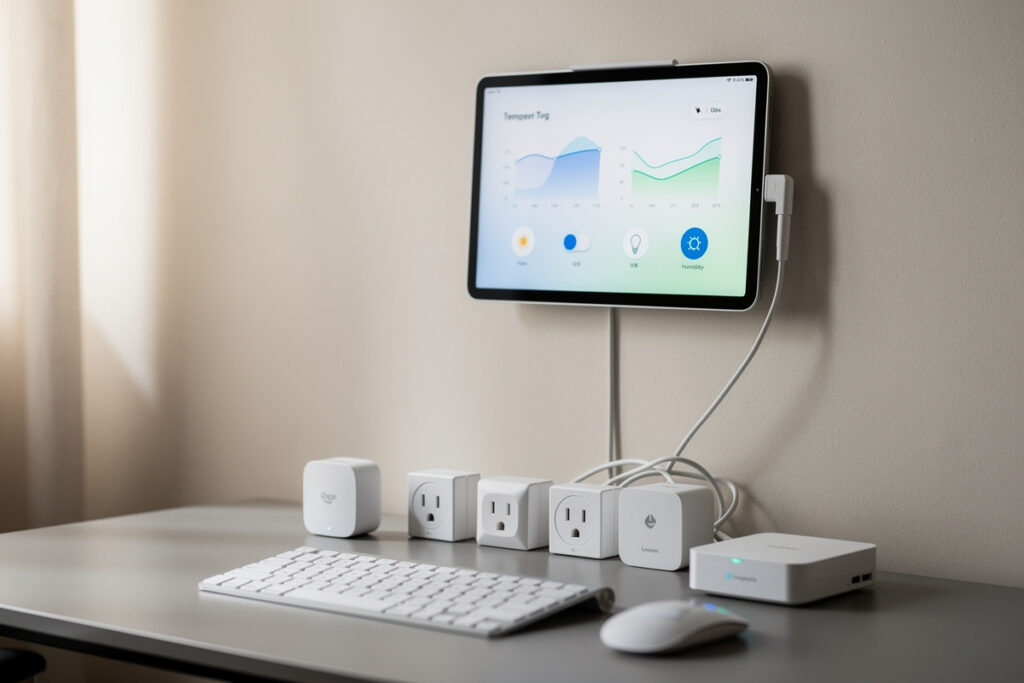
A smart temperature and humidity sensor paired with a smart plug holds the 55°F and 75% humidity a salami curing chamber needs — smart temperature humidity food preservation that a $35 Zigbee sensor and a $15 plug deliver cheaper than any standalone controller.
The same automation rig already runs wine cellars and cheese caves, and in my setup the Home Assistant hub that handles the grow lights and the sauna pre-heat also manages the curing chamber. The compressor cycles on a smart plug schedule. The humidifier kicks in when the sensor reports below 72% RH. The dehumidifier fires at 78% RH. The whole loop runs without me opening the door — which matters, because every time you open a curing chamber you lose humidity and temperature stability for 20–30 minutes while the system recovers. The smart-home layer also gives you phone alerts, data logging, and fallback routines that a $200 standalone thermostat cannot match. This article covers the sensor-to-plug-to-automation chain. The curing-chamber climate science — why 55°F and 75% RH, what happens at 80% RH, how case hardening forms — lives on curingchamber.com’s climate control guide. What I am covering here is the smart-home layer: the hardware, the automations, and the fail-safes.
The Sensor That Does the Work
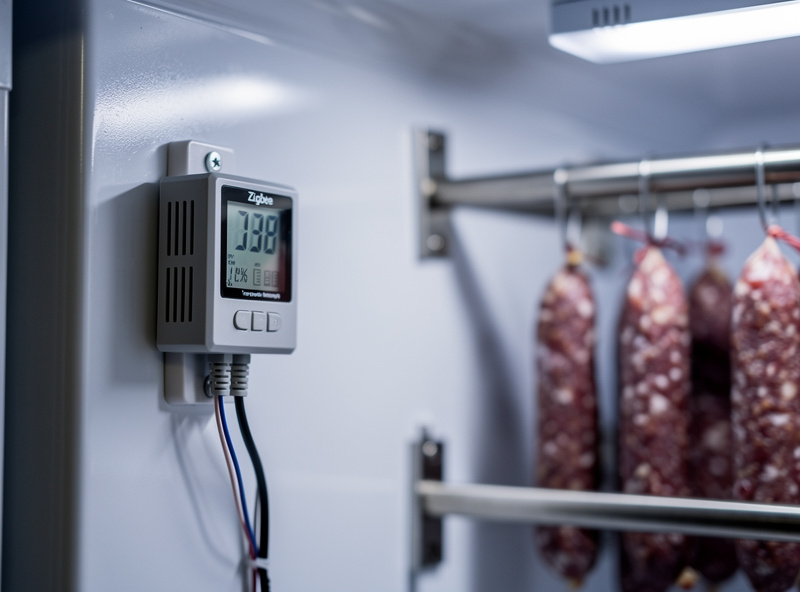
A curing chamber needs temperature accuracy within ±1°F and humidity accuracy within ±3% RH — tighter than what most “smart home” sensors advertise. The sensors that actually deliver are the ones with an SHT31 or SHT40 chip, which is the same sensor element used in dedicated curing chamber controllers like the Inkbird and Auber units. Zigbee sensors built on this chip — the Aqara temperature/humidity sensor and the Sonoff SNZB-02 — report every 5–60 seconds and hold calibration within ±0.5°F and ±2% RH over a 6-month period, which is the window between chamber deep-cleans where recalibration is needed anyway. Tight control is not vanity: FDA’s bacterial pathogen growth and inactivation data show Listeria monocytogenes growing slowly even down around 31°F and continuing to grow well above 86°F, and Staphylococcus aureus can start producing its heat-stable toxin at internal temperatures above roughly 50°F once water activity stays high enough — both reasons a curing chamber that drifts warm or wet for hours at a time is a real safety problem, not just a quality one.
Placement matters more than sensor quality in a small chamber. The sensor should sit at meat level — the middle shelf, not the top or bottom — because temperature stratifies in a fridge conversion, with a 2–4°F difference between the top and bottom shelves. Humidity follows the opposite gradient: the bottom is 3–5% RH higher than the top because cold, moist air sinks. A sensor taped to the top shelf and a second one at meat level on the middle shelf gives you the delta. A complete smart home sensor setup with two sensors costs about $60 and tells you more about your chamber’s microclimate than a single $200 standalone controller ever will.
The Smart Plug Schedule That Runs the Compressor
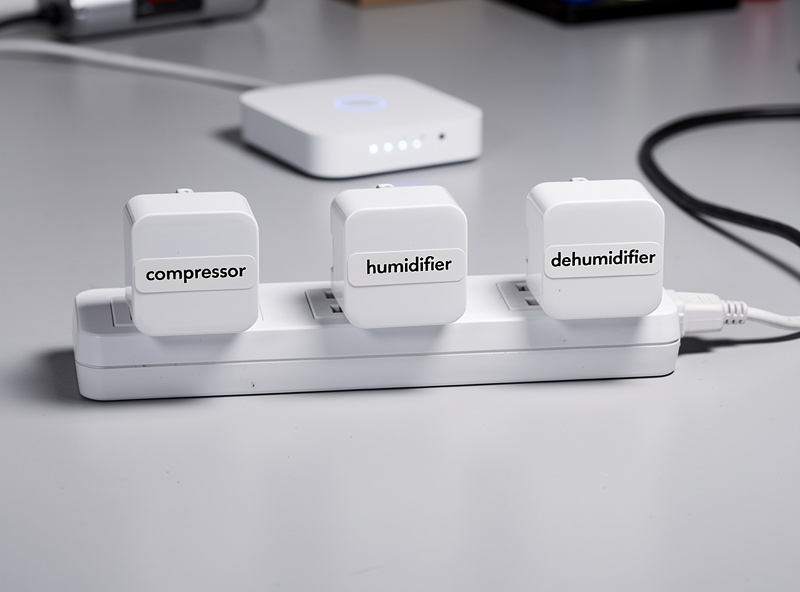
A curing chamber compressor does not run continuously. It cycles on for 5–15 minutes every 30–60 minutes to maintain temperature, and the cycle pattern changes as the chamber load changes — a full chamber of fresh salami with high moisture content cools differently than a nearly-empty chamber of finished product. A smart plug on a schedule plus a temperature-triggered override gives you both the baseline rhythm and the reactive control. USDA’s FSIS guideline for fermented, salt-cured, and dried products puts the drying/holding phase for dry fermented sausage in a 50–65°F band with 65–85% relative humidity, with tighter product-specific targets inside that range depending on the sausage type — which is exactly the envelope the timed-cycle-plus-override approach is designed to defend.
The automation logic in my setup is three rules:
- Baseline cycle: The compressor smart plug runs for 8 minutes every 45 minutes — enough to hold 55°F in a 4.4-cubic-foot fridge conversion at 68°F ambient room temperature.
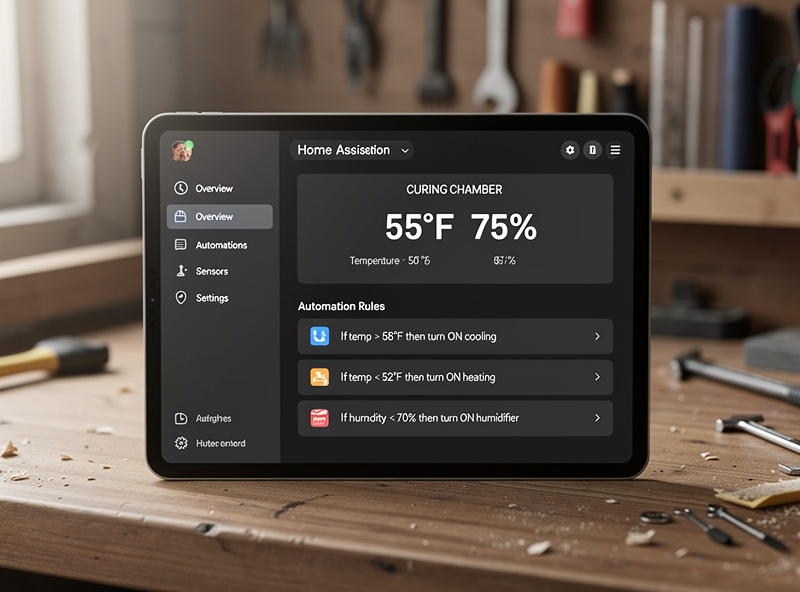
- Temperature override: If the sensor reports above 57°F for more than 2 minutes, the plug turns on immediately regardless of the schedule and stays on until the sensor reads 54°F.
- Defrost lockout: After the compressor turns off, a 5-minute cooldown timer prevents it from restarting — short-cycling a compressor kills it in months, and the 5-minute lockout is what refrigerator control boards enforce for the same reason.
This is not a generic “turn on at X temperature” binary thermostat. It is a timed cycle with an override, which is what commercial curing chambers run. A dumb thermostat with a 2°F hysteresis band swings the chamber between 53°F and 57°F over an hour. The timed-cycle-plus-override approach keeps the band at 54–56°F, which is half the swing and measurably better for salami drying — case hardening rates drop when the temperature envelope tightens.
Humidity Control That Does Not Fight Itself
The most common failure in automated humidity control is the humidifier and dehumidifier fighting each other: the humidifier kicks in at 72% RH, overshoots to 78% RH, the dehumidifier kicks in, undershoots to 70% RH, and the cycle repeats endlessly. The fix is a deadband: a 5–6% RH gap between the humidifier trigger and the dehumidifier trigger, so they never run simultaneously. In a curing chamber, that means humidifier on below 72% RH, off above 75% RH. Dehumidifier on above 78% RH, off below 75% RH. The 3% gap in the middle (75–78%) is the happy zone where neither device runs.
In my chamber, you can hear when the deadband is wrong. A short-cycling compressor clicks on for 90 seconds, off for two minutes, on again — a nervous tick of a sound, with the relay snapping behind the back panel every couple of minutes. A healthy 30-minute cycle hums for eight or nine minutes and then the chamber goes quiet, and when I open the door the air smells cold and faintly meat-sweet, not the sour off-note that creeps in when humidity has been bouncing. The give-away on the wall is condensation beading on the cold spots near the compressor coil — that means the dew point is chasing the humidifier and the deadband needs widening.
Two smart plugs run this — one for the humidifier, one for the dehumidifier — and a single Zigbee sensor feeds both automations. The total hardware cost is $50 for the two plugs and the sensor. A dedicated Inkbird humidity controller costs $45 and does the same thing, but the smart-home version gives you phone alerts when humidity drifts outside the deadband for more than 15 minutes, which is the signal that the humidifier reservoir is empty or the dehumidifier tray is full. A standalone controller sitting in the basement does not tell you anything until you walk down there and check.
This is the same automation pattern that a smart home automation setup runs for grow tents, wine cellars, and mushroom fruiting chambers. The hardware is interchangeable — the sensor-to-plug-to-deadband logic is the same. What changes per application is the setpoints: 55°F/75% RH for salami, 50°F/70% RH for cheese aging, 60°F/85% RH for mushroom fruiting, 75°F/60% RH for a wine cellar. One Home Assistant instance can run all four environments simultaneously on different smart plugs with different sensors, which is what makes the smart-home layer worth building for a multi-project workshop.
As an Amazon Associate I earn from qualifying purchases.
Frequently Asked Questions
Can I use a regular smart home temperature sensor for a curing chamber?
Yes, if it uses an SHT31 or SHT40 sensor chip with ±0.5°F and ±2% RH accuracy. Budget sensors without a specified accuracy rating can drift 5–10°F in a humid chamber, which ruins salami. Confirm the sensor chip before buying — SHT31-based Zigbee sensors cost $15–25.
How many smart plugs do I need for a curing chamber automation?
Three: one for the compressor, one for the humidifier, and one for the dehumidifier. A fourth plug can run a small circulation fan if the chamber needs additional airflow. Total hardware cost for the smart-home layer is about $60–80 for sensors and plugs.
What happens to the curing chamber if the Wi-Fi goes down?
Zigbee-based sensors and plugs continue running their programmed schedules and temperature overrides locally — they do not need Wi-Fi or internet once configured. The automations run on the Home Assistant hub, which operates on local Zigbee radio even when internet is down. Cloud-only smart plugs are the wrong choice for this application.
How often should I recalibrate the sensors in a curing chamber?
Recalibrate every 3–6 months. Humidity sensors drift 2–5% RH over time from aerosolized salt and fat particles in the chamber air. Calibrate with a saturated salt test (sodium chloride = 75% RH at room temperature) or a Boveda calibration pack. Mark the calibration date and set a reminder in Home Assistant.
Can I use a smart thermostat instead of a smart plug for temperature control?
No. Smart thermostats are designed for whole-room HVAC control with 1–2°F swing tolerance. A curing chamber needs tighter control and the compressor is a simple on/off load that a smart plug handles better. A smart plug rated for 15A handles a fridge compressor without issue.
What is the deadband and why does it matter for humidity control?
The deadband is the gap between humidifier and dehumidifier trigger points — typically 5–6% RH — that prevents both devices from running simultaneously. Without a deadband, the humidifier and dehumidifier oscillate against each other, consuming power and destabilizing the chamber. Set humidifier off at 75% and dehumidifier on at 78% for a 3% neutral zone.
Related Articles
- Smart Home Automation Guide: Voice Assistants, Protocols and Routines
- Best Smart Home Sensors 2026: Complete Buyer Guide
- Best Smart Plugs 2026: Complete Buyer Guide
- Best Smart Home Energy Management Systems 2026
- Smart Home for Beginners: Complete 2026 Setup Guide