Smart Dehumidifiers: Basement and Crawlspace Picks
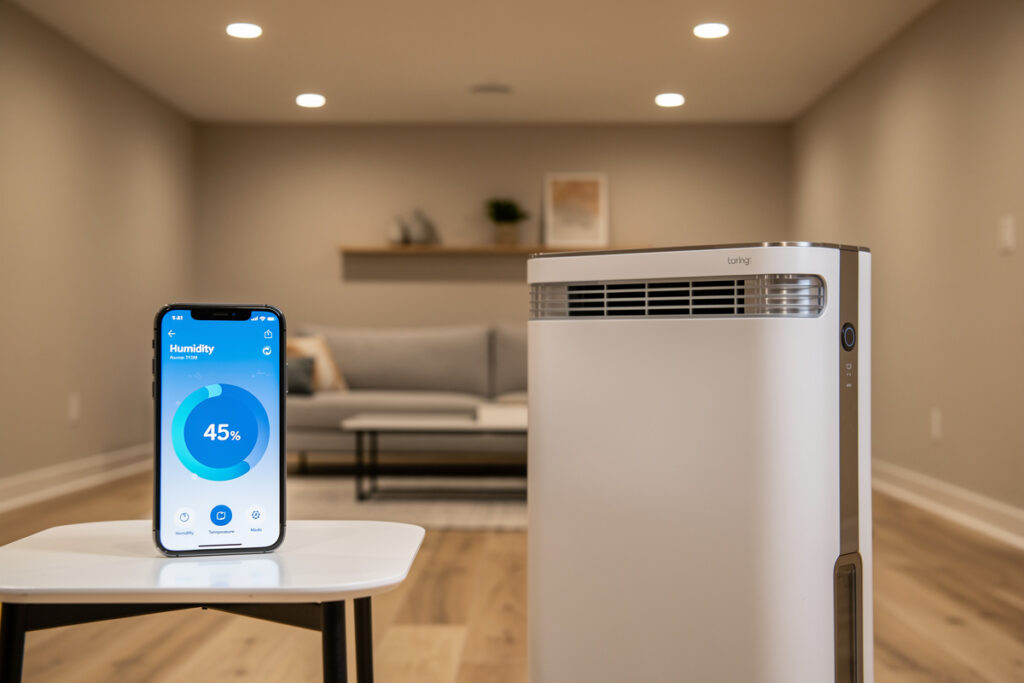
A smart dehumidifier reads humidity automatically, runs only when needed, drains continuously into a hose, and alerts you when the bucket fills. The EPA’s guidance on mold and moisture is that damp materials left wet for more than 24-48 hours are at real risk of growing mold, and basements that sit above 60 percent humidity keep surfaces damp long enough to hit that window; a 35 to 50 pint smart dehumidifier holds them at 50 percent setpoint for $200 to $400. This guide covers sizing (pints per day matter), drainage options, the four picks worth buying in 2026, and what makes “smart” worth $50 over a manual dehumidifier.
Quick Answer: Best Smart Dehumidifier 2026
For a finished basement (1,200 to 2,000 sqft), the Midea Cube 50-Pint ($380) is the top pick — built-in drain pump, smart wifi, target setpoint, very quiet. For unfinished basements with floor drains, the Frigidaire Gallery FGAC5044W1 ($350) drains by gravity through an included hose. For small bedrooms or RV use, hOmeLabs HMM4000A ($290) at 35 pints handles up to 800 sqft. Skip anything under 25 pints per day for adult-size spaces.
Why “Smart” Matters Here
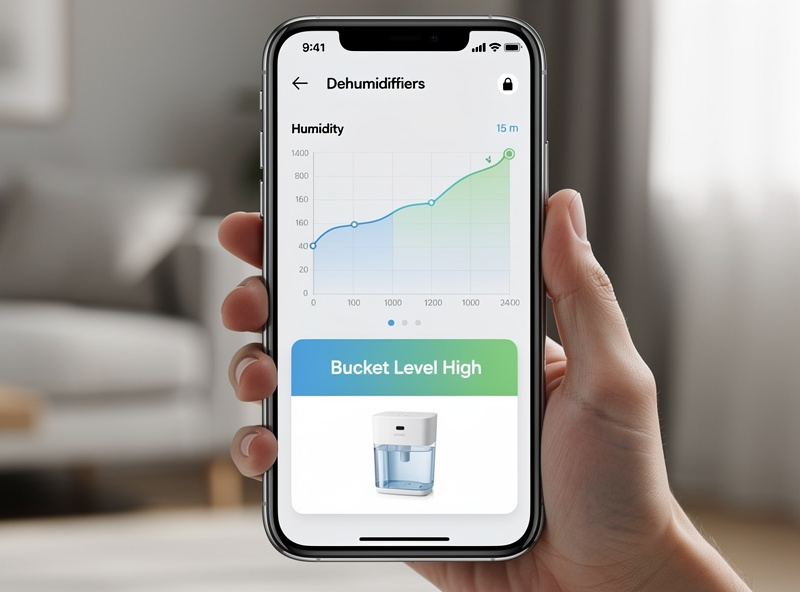
Manual dehumidifiers run at fixed power until you turn them off. They overcool, overdry, and waste 30 to 50 percent more electricity than smart units. Smart dehumidifiers read humidity continuously, ramp speed up and down to hit a setpoint (typically 45 to 50 percent), and shut off when the bucket fills.
The four smart features that matter:
- Target humidity setpoint — set 50 percent and the unit cycles on and off to hold it.
- Bucket-full alerts — push notification when reservoir hits 95 percent. Critical for basements you don’t visit daily.
- Drain pump or gravity drain — eliminates emptying buckets at all if you have a sink or floor drain.
- Schedule and routines — run only during off-peak electricity hours, or only when humidity sensor (separate device) detects threshold.
For the broader humidity-sensor side of this loop, the Smart Humidity Sensor for Basement guide shows how a separate sensor placed at floor level catches problems the dehumidifier sensor misses.
Sizing: The Pints-Per-Day Calculation
Dehumidifier capacity is measured in pints per day under the current DOE/AHAM test standard of 65°F/60% RH, adopted in 2019 to better reflect cool basement conditions (the older 80°F/60% RH standard rated the same hardware at a higher, less realistic pint number). Real-world output is typically 70 to 80 percent of rated capacity.
| Space | Square Footage | Recommended Pint Capacity | Real-World Output |
|---|---|---|---|
| Bedroom (moist) | 200-400 | 20-30 pint | 14-24 pints/day |
| Living room (slightly damp) | 400-800 | 30-35 pint | 21-28 pints/day |
| Finished basement (damp) | 800-1,500 | 35-50 pint | 25-40 pints/day |
| Unfinished basement (wet) | 1,500-2,500 | 50-70 pint | 35-55 pints/day |
| Crawlspace | 500-2,000 | 30-50 pint (low-temp model) | 20-40 pints/day |
| Whole house | 2,500-4,500 | 70-95 pint or whole-house | 50-75 pints/day |
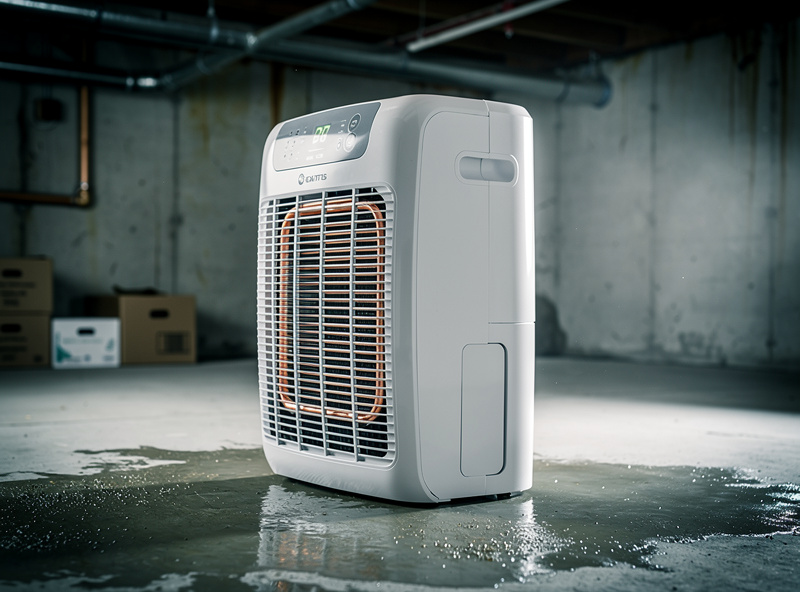
Mistake to avoid: undersizing. A 30-pint unit in a damp 1,500 sqft basement runs 24/7, never reaches setpoint, and burns out within 18 months. Always size up.
Top Smart Dehumidifier Picks 2026
Midea Cube — $380 (50 pint)
The Midea Cube has an unusual two-piece design: the dehumidifier sits on top of an integrated water tank and pump base. Detach the top, refill the bottom from a sink, or run the included pump tube to drain upward into a sink that’s higher than the unit. Smart wifi via Midea Air app + Alexa + Google.
Best for: finished basements, garages, anywhere without a floor drain. The pump-up drain is the killer feature.
Frigidaire Gallery FGAC5044W1 — $350 (50 pint)
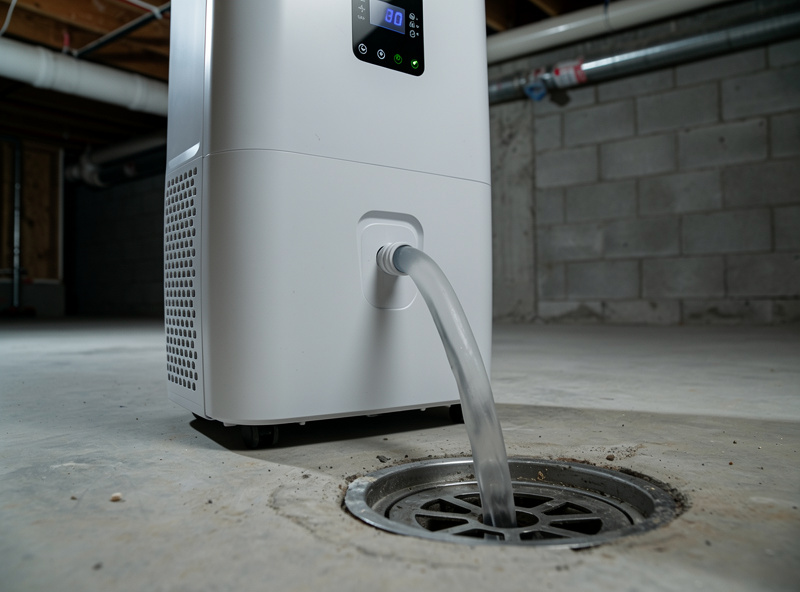
The Frigidaire Gallery is the gravity-drain pick. Hook up the included hose to a floor drain or sump pump pit and never empty a bucket again. Energy Star certified, smart wifi via Frigidaire app + Alexa + Google. Quiet at 51 dB on low.
Best for: unfinished basements with floor drains, mechanical rooms, anywhere drainage is below the unit.
hOmeLabs HMM4000A — $290 (35 pint)
The hOmeLabs HMM4000A is the value pick. 35 pints/day handles up to 1,000 sqft. Smart wifi, app + Alexa + Google. App is less polished than Midea but functional. Bucket-only drainage (no pump) but accepts a gravity hose.
Best for: bedrooms, small finished basements, first-time smart dehumidifier buyers.
Frigidaire Gallery FFAD7033R1 — $250 (50 pint, manual)
Listed for context: not smart, but the gold standard manual dehumidifier. If you want to skip wifi entirely, this is the proven workhorse. No app, no setpoint precision, but rock-solid build and 50 pint capacity for $130 less than smart equivalents.
Drainage Options Compared
| Drainage Method | How It Works | Effort | Best For |
|---|---|---|---|
| Bucket only | Empty bucket every 1-3 days | High | Small spaces, occasional use |
| Gravity hose to floor drain | Hose runs from unit to drain below | None | Unfinished basements with drains |
| Built-in drain pump | Pump pushes water upward to sink | None | Finished basements, garages |
| Condensate pump (external) | External pump on top of unit | None (after install) | Retrofitting non-pump units |
For unattended basements, NEVER rely on bucket-only. The bucket-full shutoff prevents floods, but it means the unit stops dehumidifying — and a 24-hour off period in a damp basement can grow visible mold.
Smart Features in Practice
Setpoint hold: Set 50 percent. Unit cycles on at 53 percent, off at 47 percent. Manual dehumidifiers don’t do this — they run flat-out until you turn them off.
Energy schedule: Run only 9 PM to 7 AM (off-peak electricity) when grid pricing is lowest. Saves 20 to 35 percent on operating cost in time-of-use markets.
Frost-free operation: Modern smart units throttle output below 41°F to prevent coil icing. Critical for cold basements (under 60°F) where dumb dehumidifiers freeze up and stop working.
Routine integration: When the basement humidity sensor (separate device) reads above 60 percent, automatically run dehumidifier on max and send alert. This is the closed-loop automation that justifies the smart layer.
For the protocol context, see the Voice Assistants and Smart Home Protocols guide.
Smart Features That Don’t Matter
Voice activation. “Alexa, turn off basement dehumidifier” — useful exactly twice per year. Not worth paying for alone.
Air ionizer add-on. Some smart dehumidifiers include ionizers. EPA does not recommend ozone-emitting ionizers. Disable.
UV sterilization claim. Marketing fluff on most consumer dehumidifiers — UV exposure inside the air path is too brief to kill anything meaningful.
Operating Cost
A 50-pint dehumidifier draws 600 to 800 watts when running and typically runs 12 to 18 hours per day in damp conditions. At $0.15/kWh that’s $1.10 to $2.15 per day, $33 to $65 per month during humid season (May through September in most of the US).
Smart features can cut this 20 to 35 percent through setpoint precision and time-of-use scheduling. Annual savings: $40 to $90.
| Capacity | Wattage | Cost/Day (12 hr/day) | Season Cost (May-Sep) |
|---|---|---|---|
| 30 pint | 400-500W | $0.72-$0.90 | $110-$135 |
| 50 pint | 600-800W | $1.08-$1.44 | $160-$215 |
| 70 pint | 800-1,000W | $1.44-$1.80 | $215-$270 |
For broader energy management, the Best Smart Home Energy Management Systems guide covers how to schedule high-draw appliances around solar and time-of-use rates.
Maintenance
Empty and rinse bucket weekly even if using gravity drain (algae grows in residual water). Wash washable filter monthly with mild detergent. Check drain hose for kinks or clogs every 30 days. Check coils for ice in cold environments — if visible, raise thermostat or relocate to a warmer area.
Lifespan: 5 to 8 years for quality units. Compressor failure is the most common end-of-life issue. Smart units don’t last longer than manual ones — the smart components add a small failure surface but generally outlast the compressor.
Common Mistakes
Running 24/7 without setpoint. Wastes electricity, overdriers (humidity below 30 percent has its own problems).
Closing room doors. Dehumidifier needs air circulation. Leave doors open or run a small fan.
Skipping the gravity drain. Bucket-only on a 50-pint unit means emptying 6+ gallons daily. Set up gravity drain in 5 minutes — never empty again.
Ignoring cold-weather throttling. Most consumer dehumidifiers stop working effectively below 60°F. For cold basements, buy a low-temp model (Aprilaire, Santa Fe) or accept seasonal limitation.
For the broader environment around dehumidifiers, see the Smart Air Purifier guide — running purifier and dehumidifier together in damp basements halves visible mold growth in finished spaces.
As an Amazon Associate I earn from qualifying purchases.
Automating My Dehumidifier
My basement dehumidifier runs on a smart plug with energy monitoring, controlled by a Zigbee humidity sensor at floor level. When basement humidity hits 60%, the dehumidifier kicks in and runs until it drops to 50%. The energy monitoring tells me the draw per cycle, about 180 watts for a 25-minute run, roughly $3 a month. That is far cheaper than the mold remediation it prevents.
Sensor placement matters: at chest height the basement reads lower than at floor level where condensation forms. I put the sensor 12 inches off the floor to catch the spike before the concrete starts sweating.
What size smart dehumidifier do I need for a basement?
For 800 to 1,500 sqft finished basements, 35 to 50 pint capacity is appropriate. For 1,500 to 2,500 sqft unfinished or wet basements, choose 50 to 70 pints. Always size up — undersized units run 24/7, never reach setpoint, and burn out within 18 months.
Are smart dehumidifiers worth it?
Yes for finished basements, garages, or anywhere you don’t visit daily. The bucket-full push alert prevents flood damage; setpoint hold cuts electricity 20 to 35 percent vs manual units. Smart layer adds about $50 over comparable manual units, recouped in 1 to 2 humid seasons.
What is the best smart dehumidifier for 2026?
Midea Cube 50-Pint ($380) for finished basements with built-in drain pump. Frigidaire Gallery FGAC5044W1 ($350) for unfinished basements with floor drains. hOmeLabs HMM4000A 35-Pint ($290) for value or smaller spaces.
Should a smart dehumidifier run all the time?
No. Set target humidity (45 to 50 percent for basements) and let the smart unit cycle on and off automatically. Continuous run mode wastes electricity and overdries air below 30 percent, which has its own problems.
What humidity should I set my dehumidifier to?
45 to 50 percent for most basements and living spaces. Below 40 percent is unnecessarily dry; above 60 percent grows mold and dust mites. The EPA recommends keeping indoor humidity below 60 percent, ideally between 30 and 50 percent.
Can dehumidifiers work in cold basements?
Standard refrigerant dehumidifiers lose efficiency below 60°F and stop working effectively below 41°F due to coil icing. For cold basements (under 60°F year-round), buy a low-temp model from Aprilaire or Santa Fe — they cost $700 to $1,800 but work down to 33°F.
The one thing I would not automate is the drain pump. Let the dehumidifier’s built-in pump or gravity drain handle condensate removal, and only automate the power cycle. Mixing pump control into the HA automation adds complexity and failure modes for zero practical benefit.
Related Articles
- Smart Air Purifier 2026: Complete Buyers Guide
- Smart Humidifier: Whole-Home and Room Picks
- Smart Humidity Sensor for Basement
- Best Smart Home Energy Management Systems
- Best Smart Home Sensors