Smart Faucet Buyers Guide 2026: 4 Tiers Compared
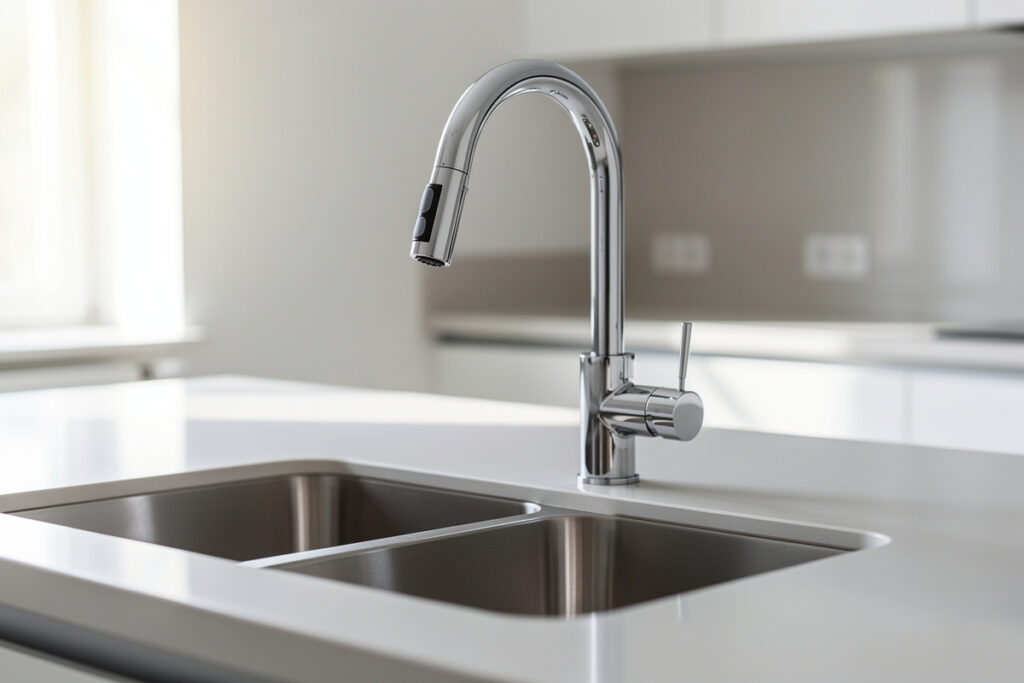
A smart kitchen faucet handles 20-50 daily hand-on-handle moments with voice commands, motion sensing, or app-controlled measured pours. In households where someone cooks with raw protein regularly, the touch-free hygiene alone matters more than any other connected kitchen feature — more than a smart oven’s preheat notification, more than a smart air fryer’s recipe push, more than any gadget in the pantry. The 2026 market runs from $329 entry-level Wi-Fi models to $899 premium units with voice-measured pours, recipe integration, and water-usage monitoring.
But the real buying decision comes down to which of three jobs you need the faucet to do: keep dirty hands off the handle, pour measured amounts without a measuring cup, or catch leaks before they flood the cabinet underneath. Most households need only one of those three, and the tier that matches the primary job determines whether the premium over a $200 standard pull-down genuinely delivers or becomes an expensive conversation piece that guests remark on and owners stop using after month four.
Job One: Keeping Raw Protein Off the Handle
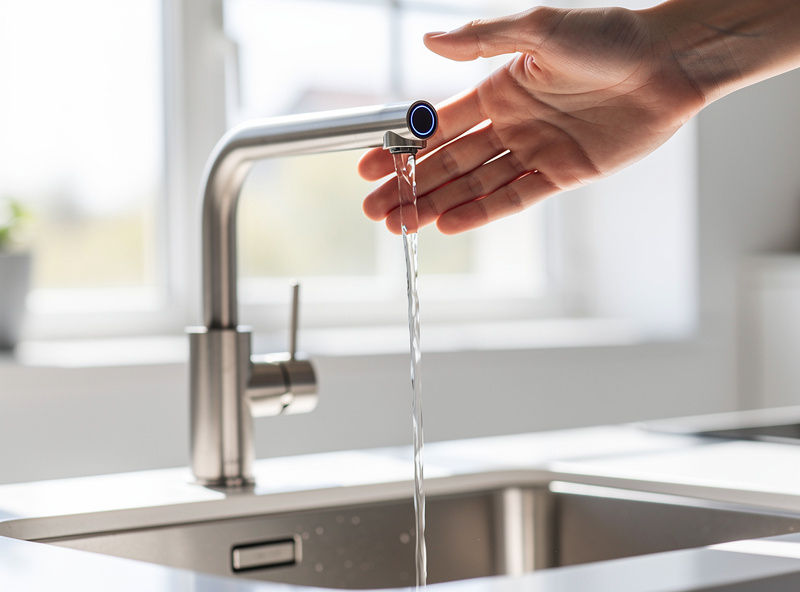
The wave-on/wave-off motion sensor is the feature most owners cite as the reason they stopped regretting the upgrade, and it is also the simplest connected feature on any smart faucet. A standard pull-down faucet requires gripping the handle with whatever is on your hands at that moment — raw chicken juice, bread dough, garlic paste, burger grease, the residue from handling raw fish. The contamination vector is not theoretical: every food-safety resource emphasizes washing hands after handling raw protein, but nobody talks about the handle you just touched with those same hands, which now carries the same bacteria until the next person wipes it down. A motion-sensing faucet removes that vector entirely. Pass your hand within 4-6 inches of the spout to start the flow, pass again to stop. No voice assistant, no app, no phone within reach required.
This is the entry-level tier ($329-$449), and it captures the daily-use benefit at the lowest cost of any smart faucet category. Touchless sensor faucets operate independently of Wi-Fi, Alexa, Google Home, or any cloud dependency — the wave sensor is a self-contained infrared or capacitive proximity detector wired to a solenoid valve, and it works the same whether your router is online or not. That independence matters more than it sounds. In a kitchen where the faucet is the most-touched surface after the refrigerator handle, a sensor that works without any network dependency is a reliability feature, not just a convenience one.
For a household whose primary need is hygiene during food prep, this tier alone solves the problem completely. Spending more on voice control or premium features only makes sense if the additional jobs — measured pours or leak monitoring — are genuine friction points in your daily cooking, not aspirational features that sound impressive in a product video. The entry-level touchless tier is also where the gap between a smart faucet and the $30 alternative (a touchless soap dispenser plus a standard faucet operated by wrist or elbow) is narrowest: both solve the hygiene problem, but the faucet-integrated sensor is more natural to use because you never adjust your behavior at all.
Job Two: Measured Pours Without Reaching for a Measuring Cup
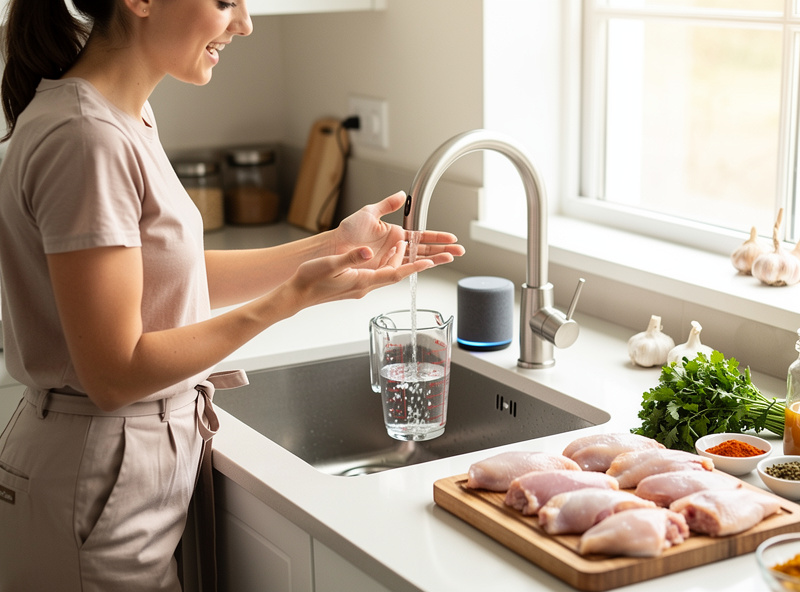
The voice-connected tier ($449-$599) adds the ability to request specific water amounts by voice command, and this is where a smart faucet stops being a hygiene upgrade and starts being a cooking tool. Saying “Alexa, fill 2 cups warm water” triggers the faucet to dispense close to 16 oz at the temperature specified — no measuring cup, no guessing whether the stream is filling fast enough to overflow before you can stop it, no second trip to the sink because the first pour was short.
Delta’s own VoiceIQ documentation notes the metered pour holds accuracy above roughly a half cup (4 oz) but gets less precise on very small requests. In practice, this means the feature is reliable for the volumes that matter in cooking — 1 cup, 2 cups, 500ml, a pint — and slightly loose on requests below the half-cup threshold. It is adequate for skipping a measuring cup in most baking and cooking scenarios, though not lab-grade precision and not a replacement for a kitchen scale when gram-level accuracy matters.
The premium tier ($599-$799) extends measured pour with recipe-pushed quantities. The Moen U and Delta Touch2O lines accept pour commands from a connected recipe app: a sourdough starter formula requesting 240g flour and 120g water sends 120g of warm water straight from the faucet, eliminating the measuring-cup step entirely. For bakers who already weigh ingredients on a smart kitchen scale, this closes the loop between recipe and dispensing in a way that a standard pull-down cannot match. The faucet becomes the last piece in a connected baking workflow: scale weighs the flour, the recipe app calculates the hydration, and the faucet dispenses the exact water weight the formula demands.
The practical caveat: recipe-pushed pours depend on the brand app staying current and the Wi-Fi staying connected. If the app server is down or your internet drops mid-bake, you fall back to the manual handle and a measuring cup. That is not a catastrophe — bakers managed without connected faucets for centuries — but it is worth knowing that the recipe-push feature is a cloud-dependent convenience, not a local-controlled guarantee.
As an Amazon Associate I earn from qualifying purchases.
Job Three: Catching Leaks Before They Flood the Cabinet
Water-usage tracking and conservation alerts form the third pillar, available on the premium and filtration tiers. The faucet logs daily and weekly water consumption through its app and flags unusual patterns — a slow cartridge leak running overnight, a faucet left running unattended, a supply line developing a seep under the sink. The practical payoff is catching a stuck cartridge or a running faucet before it turns into a real water bill or, worse, cabinet damage from a slow leak that went undetected for weeks.
The actual dollar amount saved depends entirely on local water rates and how long the leak would have run otherwise, so treat any flat savings figure in a product description with skepticism. The feature’s value is not in guaranteed savings but in early detection — the same logic that makes a $20-40 leak sensor under the sink one of the highest-value smart-home purchases a kitchen can make.
The filtration tier ($699-$899) adds integrated undersink filtration with filter-life tracking. Instead of replacing the cartridge on a calendar guess — most people guess wrong, either replacing too early and wasting money, or too late and drinking unfiltered water for weeks — the faucet counts actual gallons through the filter and pings when replacement is due. It also provides cold-water-on-tap, consolidating a separate filter faucet into the main spout and freeing a sink hole for a soap dispenser or an instant-hot tap.
The Price Ladder: What Each Band Adds Over a Standard Pull-Down
| Category | Price Band | Form Factor | Primary Connected Capability |
|---|---|---|---|
| Touchless Sensor | $329-$449 | Pull-down with wave sensor | Motion on/off only, no app |
| Voice-Connected | $449-$599 | Pull-down with voice plus sensor | Voice activation and measured pour |
| Premium Smart | $599-$799 | Pro-style spring or pull-down | Recipe-push pours and usage history |
| Filtration Smart | $699-$899 | Integrated filter plus smart features | Filter tracking and cold-water-on-tap |
Touchless Sensor covers the hygiene job at the lowest entry cost. Voice-Connected adds measured pour for cooking and baking. Premium layers in recipe integration and water-usage logging. Filtration consolidates a separate undersink filter into the faucet body. Most households land on the tier that solves their primary job and never feel the need to climb higher — the buyer who needs touch-free hygiene does not need recipe-pushed sourdough hydration, and the buyer who wants voice-measured pours does not necessarily need filter tracking.
Moen, Delta, and Kohler: Who Leads What
Moen, Delta, and Kohler dominate the 2026 smart faucet category, and each brand leads on a different axis that maps cleanly onto which of the three jobs matters most to you. Moen pulls ahead on voice-measured-pour features through the Moen U product line, which has the most polished recipe-push integration of the three. Delta leads on touch and touchless integration with the smoothest sensor activation via Touch2O and VoiceIQ — the wave sensor on Delta’s touchless models has the most consistent activation zone in side-by-side owner comparisons. Kohler stakes out the premium industrial-design territory with the Kohler Sensate and Konnect lines — officially priced around $870-900 direct from Kohler, well above the $649 occasionally quoted for it on third-party listings that may not include the full Konnect connectivity package.
The pricing breakdown by brand and model: Moen U runs roughly $500-550 in common finishes. Delta Touch2O VoiceIQ complete faucets typically run $650-900-plus depending on finish and collection. Kohler Sensate sits at the top of the range at $870-900 direct. All three brands support Alexa and Google Home. Apple HomeKit is the holdout that shapes the shortlist: Moen U has supported it on 2024+ models, and Kohler’s Konnect app adds HomeKit alongside Alexa and Google Home. Delta’s VoiceIQ skips HomeKit entirely, sticking to Alexa and Google Assistant only. If you run an Apple Home household, that eliminates Delta from contention before any other consideration — and it is worth confirming before purchase rather than discovering it during setup.
Off-brand smart faucets — Amazon-sold no-name models — often ship with weak or nonexistent app support. The faucet body itself works fine as a plumbing fixture, but the connected layer degrades fast with no firmware updates and no server-side maintenance. The faucet industry’s smart layer is still young enough that brand choice is also a software-support choice, and Moen, Delta, and Kohler are the only three with multi-year track records of maintaining their apps. Sticking to the big three unless absolute price is the overriding constraint is the consistent recommendation across owner forums and professional plumber reviews.
Power, Plumbing, and the Under-Sink Reality
Sensor activation distance varies by model but typically lands at 4-6 inches from the spout. Premium models allow app-based adjustment of that zone. A too-tight activation distance produces false stops mid-wash because your hands drift out of range while scrubbing; a too-wide one triggers accidental activation when you lean over the sink to reach something on the windowsill or when a pet walks past at counter height. The sensor range is a comfort factor that is difficult to assess from a spec sheet — if you can test a display model in person, wave your hand at various distances and angles before committing.
Power source splits between hardwired 6V and battery, and the choice has practical consequences. Most smart faucets accept either a hardwired connection or a 6-pack of AA batteries. Moen’s own guidance puts battery life at roughly a year on six AA alkalines, with usage frequency and water temperature shifting that estimate in either direction — a household running the faucet 40+ times per day will see shorter battery life than a vacation home. Hardwired eliminates battery maintenance entirely but requires an outlet under the sink, which may mean running a new circuit behind the cabinet wall during installation if one is not already present. Battery-powered models are simpler to install and have no cord management issues, but they introduce a periodic maintenance task that is easy to forget until the sensor stops responding mid-cook.
Installation complexity mirrors a standard pull-down faucet: 3-hole or single-hole sink, same supply-line connections, same escutcheon and mounting hardware. A competent DIYer finishes in about 90 minutes; a plumber in 60. The smart layer adds 15-30 minutes for Wi-Fi pairing, firmware update, and voice-assistant linking — assuming the firmware server is responsive and the app does not crash during account creation, which is not always a safe assumption on launch day for new models. Smart faucets are often heavier than their dumb equivalents because of the motion-sensor electronics and solenoid valve packed into the spout — the Moen Arbor Smart, for instance, is noticeably heavier than a standard Arbor pull-down. If you are replacing an existing faucet, verify the mounting hole spacing and supply-line shut-off valves before starting, because discovering a corroded shut-off valve mid-install turns a 90-minute job into a half-day project.
Warranty terms matter more here than on a standard faucet, and they are where the big three brands differentiate. Moen, Delta, and Kohler all offer lifetime coverage on the faucet body and finish — the same standard they apply to their non-smart equivalents, which typically last well over a decade. But the connected components — Wi-Fi module, sensor electronics, voice hardware, solenoid valve — carry separate 1-to-5-year terms. Delta’s own warranty page covers electronic parts for 5 years from purchase, separate from the lifetime body coverage, which tells you roughly how long the manufacturer expects the smart layer to hold up before something inside it needs attention. Budget for a possible connected-component repair or replacement inside that warranty window rather than assuming the sensor and Wi-Fi module will outlast the plumbing.
Where Smart Faucets Sit in a Local-Control Setup
I run every automation in my house through a self-hosted Home Assistant instance — Zigbee and Z-Wave on dedicated coordinators, Matter over Thread for the newer gear, MQTT as the message bus. None of the big three smart faucet brands fit into that world the way my sensors, plugs, and locks do, and anyone coming from a local-first smart-home setup needs to understand that going in. Moen U, Delta VoiceIQ, and Kohler Sensate are all cloud-first products: they talk to their own app and to Alexa or Google, not to a local hub, and there is no official Zigbee, Z-Wave, or Matter device type for a kitchen faucet as of 2026. If the goal is a device that keeps working when the internet drops, a smart faucet is not that device — the manual pull-down handle underneath the electronics is your fallback, not a local automation.
That said, the faucet can still participate in a broader automation architecture at a level above the device itself. Where I have seen this work in practice is one layer up: a Zigbee or Wi-Fi smart plug on a dedicated water-conditioning accessory, or a leak sensor under the sink feeding a Home Assistant automation that shuts a whole-home smart water valve if it detects standing water. The faucet itself stays a cloud-dependent gadget in that architecture, and the actual safety automation runs on hardware that supports local control and survives internet outages. The broader strategy of segmenting IoT traffic onto its own VLAN — covered in detail in the voice assistants and smart home protocols guide — applies directly here: put the faucet’s Wi-Fi module on the IoT VLAN alongside any other cloud-dependent device, and never route anything safety-critical through the faucet’s own app.
The practical upshot is a two-part recommendation. Buy a smart faucet for the touch-free hygiene and measured-pour convenience — those features genuinely improve daily cooking. Do not buy one expecting it to integrate into your automation stack the way a Zigbee sensor or a Shelly relay does. If end-to-end local control matters more to you than voice-measured pours, a $20-40 Zigbee or Z-Wave leak sensor under the sink paired with your existing hub delivers the one genuinely safety-relevant feature — catching a leak before it floods the cabinet — without adding another cloud account to the kitchen. For households interested in the broader energy and resource monitoring picture, a leak sensor also feeds data into the same dashboard that tracks electricity and gas usage.
The $30 Alternative: Touchless Soap Dispenser Plus Standard Faucet
The cheapest path to touch-free hand-washing during cooking is a $30 touchless soap dispenser paired with a $200 standard kitchen faucet operated by elbow or wrist. This combination covers the hygiene use case completely — your dirty hands never touch the soap bottle, and the faucet handle gets operated with a forearm or wrist rather than contaminated fingers. It loses every other connected feature: no measured pour, no voice control, no recipe push, no water-usage tracking, no filter-life alerts.
The smart faucet upgrade pays back when at least one of these conditions holds in your household. First: someone cooks with raw protein frequently enough that the daily contamination-avoidance routine of wrist-operating a standard handle feels like a recurring annoyance rather than an occasional inconvenience. Second: the household bakes or follows weighed recipes regularly enough that measured pours remove genuine friction from the workflow — not once a month, but multiple times per week. Third: someone in the household has mobility issues that make handle operation genuinely difficult, in which case the wave sensor is an accessibility feature rather than a convenience.
For simpler cooking patterns — reheating, assembling, occasional prep — the soap-dispenser-plus-standard-faucet combination delivers most of the hygiene benefit at a fraction of the cost, and the $250-$400 premium over a standard pull-down stays in your pocket. The broader smart kitchen comparison, including how a smart faucet fits alongside other connected cooking devices, lives in the smart kitchen appliances guide.
Frequently Asked Questions
Which brand leads the smart faucet category in 2026?
Moen U (roughly $500-550 in common finishes) leads on voice-measured pour features and Apple HomeKit support. Delta Touch2O VoiceIQ (complete faucets typically run $650-900-plus depending on finish and collection) leads on touch and touchless sensor integration, though it skips Apple HomeKit entirely. Kohler Sensate (officially priced around $870-900 direct from Kohler) leads on premium industrial design with Alexa, Google Home, and HomeKit support via the Konnect app.
Is the premium over a standard pull-down faucet justified?
The $250-$400 premium over a standard pull-down earns its place for households where someone cooks with raw protein 3-plus nights per week or where measured pours solve a real baking friction. Touch-free hygiene alone justifies the upgrade for households handling raw chicken or fish often. For occasional kitchen use, a $30 touchless soap dispenser plus a standard faucet covers the hygiene benefit at a fraction of the cost.
How accurate are the voice-measured pours?
Voice-connected and premium smart faucets accept measured-pour commands and dispense close to the requested amount at the specified temperature. Per Delta VoiceIQ documentation, accuracy holds well above roughly a half cup (4 oz) and gets less precise on very small pour requests. Premium tier faucets (Moen U, Delta Touch2O VoiceIQ) accept measured pours via voice or recipe-app push; mid-tier supports voice only.
What functionality depends on an internet connection?
The motion sensor and physical handle work without internet. You lose voice control, measured pours, water-usage history, and filter-life tracking when the connection drops. The faucet falls back to standard pull-down manual operation. Models with local-network features recover faster after an outage but still lose cloud-dependent functions.
How long do the connected components hold up?
The faucet body and finish last well over a decade under normal conditions — the same standard as non-smart equivalents from the same brands. The electronics are the weak link. Delta covers electronic parts for 5 years from purchase, separate from the lifetime body coverage. Budget for a possible connected-component repair or replacement inside that window rather than assuming the sensor and Wi-Fi module will outlast the plumbing.
Is DIY installation realistic for a smart faucet?
Yes — smart faucet installation mirrors a standard pull-down, taking about 90 minutes for a competent DIYer. The smart layer adds 15-30 minutes for Wi-Fi pairing and voice-assistant linking. The only meaningful difference is the power source: battery or hardwired electrical. Battery-powered models are simpler to install and typically run about a year on six AA alkalines before needing a swap.
Further Reading
- Smart Kitchen Appliances 2026: Complete Buyers Guide (parent hub)
- Smart Kitchen Scale 2026
- Voice Assistants & Smart Home Protocols Guide
- Smart Home for Beginners: Complete 2026 Setup Guide
- Best Smart Home Energy Management Systems