Best Smart Home Accessories 2026: Complete Guide
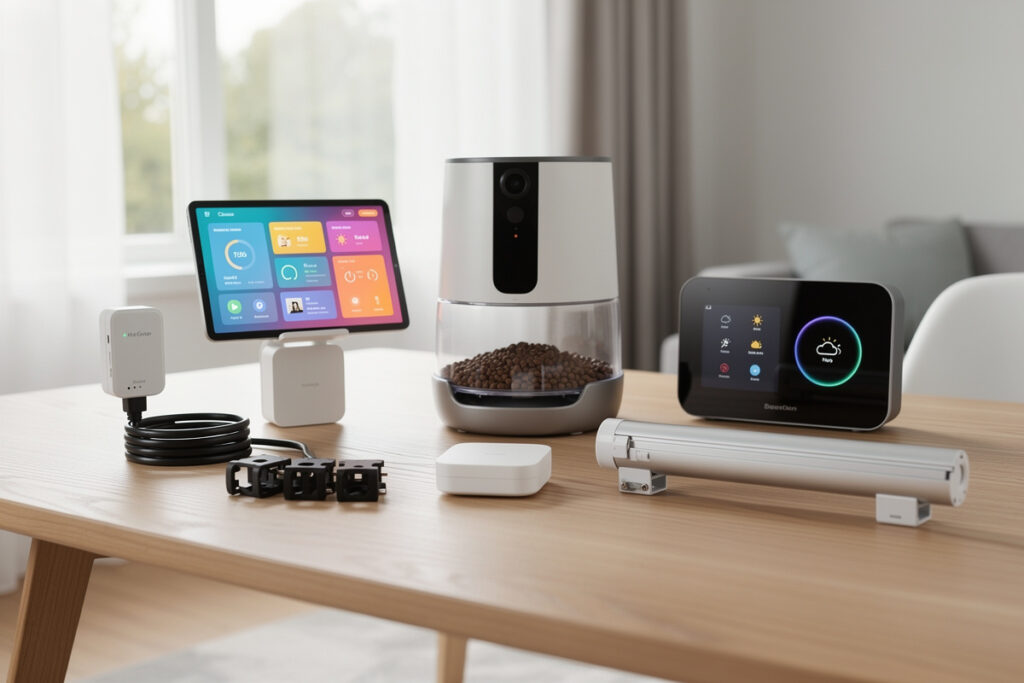
The best smart home accessories and standalone devices for 2026 include energy monitors that cut bills by 10-30%, wall-mounted tablets that serve as family command centers, smart pet feeders with cameras, automated curtain motors, intelligent sprinkler controllers, and real-time energy dashboards. These devices transform individual smart gadgets into a cohesive home automation ecosystem. The average US household wastes $200-400 annually on phantom energy loads, spends $500-700 on pet care, and loses 20-50% of outdoor water to inefficient irrigation — all solvable with the right accessories. This guide covers every device category, installation method, and cost consideration to help you choose the right standalone smart home devices.
Smart home accessories are the unsung heroes of home automation. While smart plugs, lights, and cameras get the attention, it is the energy monitors, pet feeders, and irrigation controllers that deliver the highest return on investment. The global smart home accessory market reached $8.3 billion in 2025 and is projected to grow 18% annually through 2030. Yet most homeowners overlook these devices because they do not fit neatly into standard smart home starter kits. This guide corrects that oversight.
Disclosure: HomeAutoCentral is reader-supported. As an Amazon Associate I earn from qualifying purchases, at no extra cost to you. I only recommend gear worth your money.
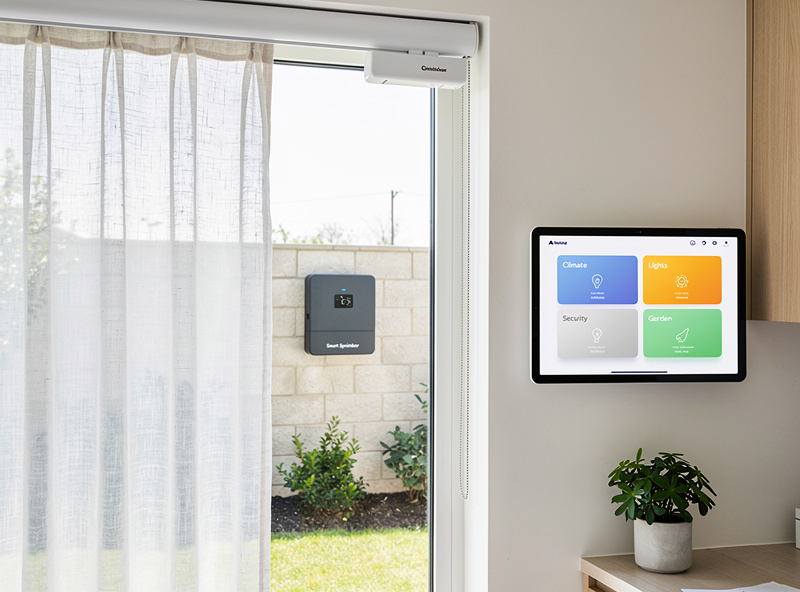
Smart home accessories are the category I find myself recommending most often — they’re the affordable, one-hour-install upgrades that actually change how a house feels. I have an electricity monitor clamped onto my panel feeding data into Home Assistant, a smart curtain opener in the bedroom that I built a sunrise routine around, and a pet feeder that solved the problem of my cat waking me at 5 AM. Each one solved a real-world friction point — none of them are gadgets for the sake of being gadgets. Here’s how the best accessories in 2026 stack up.
Quick Comparison: Smart Home Accessories 2026
| Device Category | Top Pick | Price | Savings/Value | Install Difficulty |
|---|---|---|---|---|
| Electricity Monitor | Emporia Vue Gen 2 | $100-130 | $270/year savings | Moderate |
| Wall Tablet Mount | iPad + VidaMount | $400-600 | Whole-home control | Easy |
| Energy Dashboard | Emporia Vue 2 | $100 | Real-time visibility | Moderate |
| Pet Feeder Camera | Petlibro Granary | $130 | Health + convenience | Easy |
| Curtain Opener | SwitchBot Curtain 3 | $70-90 | Energy + privacy | Easy |
| Sprinkler Controller | Rachio 3 | $150-230 | 20-50% water savings | Easy |
Smart Electricity Monitors
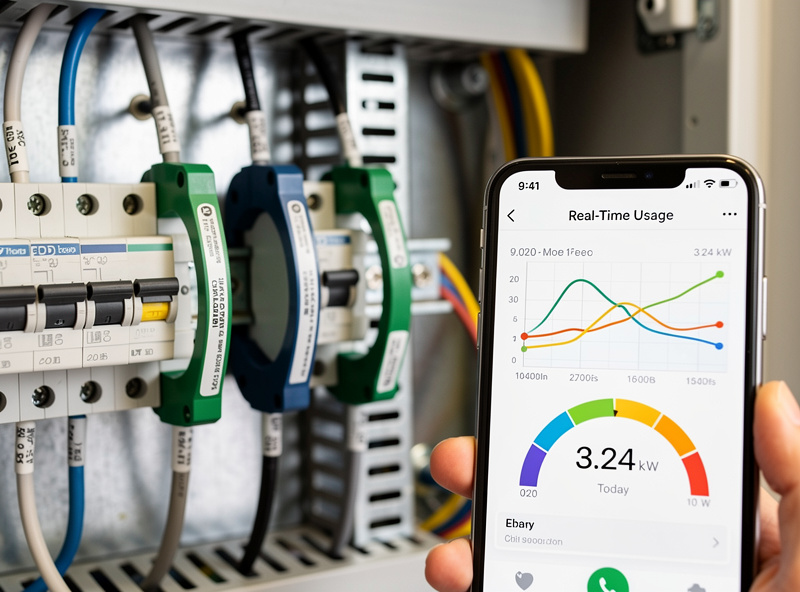
Smart electricity monitors install in your electrical panel and provide circuit-level or whole-home energy monitoring via smartphone apps. They help identify waste, optimize usage, and reduce bills by 10-30% through visibility and behavioral changes. EIA data puts the average US household at roughly 860-870 kWh monthly, and a meaningful share of that is wasted on phantom loads and inefficient appliances.
The best smart electricity monitors include the Emporia Vue Gen 2 (best overall at $100-130), Sense Energy Monitor (best AI detection at $300-350), and Eyedro Home Energy Monitor (best web dashboard at $150-200). These devices sample current and voltage thousands of times per second, calculating real-time wattage, energy consumption, power factor, and voltage stability.
AI-powered monitors like Sense analyze electrical signatures to identify individual appliances automatically — learning your refrigerator, microwave, and HVAC system over 4-6 weeks with accuracy rates exceeding 90%. Circuit-level monitors like Emporia Vue provide definitive 100% accuracy for monitored circuits by installing sensors on individual breakers.
Installation requires opening your main electrical panel — hazardous work best left to licensed electricians ($100-200). However, utility meter readers like Emporia Vue Utility Connect simply plug into smart meters, providing immediate whole-house data without any electrical work.
Wall-Mounted Tablets and Dashboard Control
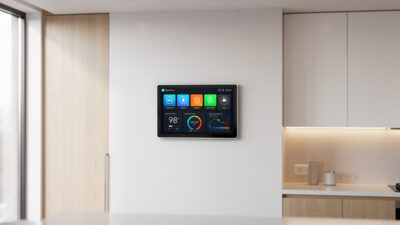
A wall-mounted tablet creates the ultimate smart home command center by providing always-accessible touch control, family dashboard visibility, and dedicated smart home interface that phones and voice assistants cannot match. Mounting an iPad or Android tablet on your wall costs $200-600 total (tablet plus mount) and delivers the smart home experience shown in architectural magazines.
The smart home tablet wall mount guide covers the iPad 10th Gen (best overall at $350-450), Samsung Galaxy Tab A8 (best Android value at $180-230), and Amazon Fire HD 10 Plus (best budget at $150). Mounting options range from surface mounts ($25-35) to recessed in-wall mounts ($60-100) to premium tilt/swivel mounts ($150-200).
Dashboard apps transform tablets into control centers: Home Assistant (most powerful, free), ActionTiles for SmartThings ($30 one-time), Apple Home App (pre-installed on iPads), and SharpTools for Hubitat (free basic, $30/year premium). Each offers customizable layouts, camera feeds, scene activation, and energy monitoring displays.
Power solutions include hardwired electrical boxes (cleanest look, $150-300 electrician cost), concealed cable routing (reversible, $10-30), and wireless charging docks (flexible, $40-80). The best mounting locations are entryways, kitchens, master bedrooms, and living rooms at 48-54 inches from floor height.
Smart Home Energy Dashboards
Setting up a smart home energy dashboard gives you real-time visibility into every watt your home consumes — revealing which devices waste power, when usage peaks occur, and how to reduce your electric bill by 10-30%. The average US household spends $1,500-2,000 annually on electricity, with 20-30% wasted on phantom loads and inefficient appliances.
The guide on setting up a smart home energy dashboard covers the Sense Energy Monitor (AI-powered device detection at $299), Emporia Vue 2 (circuit-level monitoring at $100), and Aeotec Home Energy Meter (Z-Wave integration at $100). These systems use current transformers (CT clamps) installed around main electrical feeds to measure total home consumption and employ machine learning algorithms to identify individual appliances.
Modern energy dashboards extend beyond installed hardware through direct utility integrations. Green Button Data allows downloading detailed usage information from participating utilities. Zigbee Smart Energy enables certain Emporia Vue models to connect directly to utility smart meters with no electrical panel modifications. Time-of-use optimization displays utility pricing tiers and calculates optimal usage schedules automatically.
Energy data becomes more powerful when integrated with smart home control systems. Load shedding automatically disables non-essential devices when consumption approaches demand charge thresholds. Solar self-consumption triggers discretionary loads when solar production exceeds baseline. Occupancy-based conservation combines energy monitoring with presence detection to reduce HVAC setpoints when no one is home.
Smart Pet Feeders with Cameras
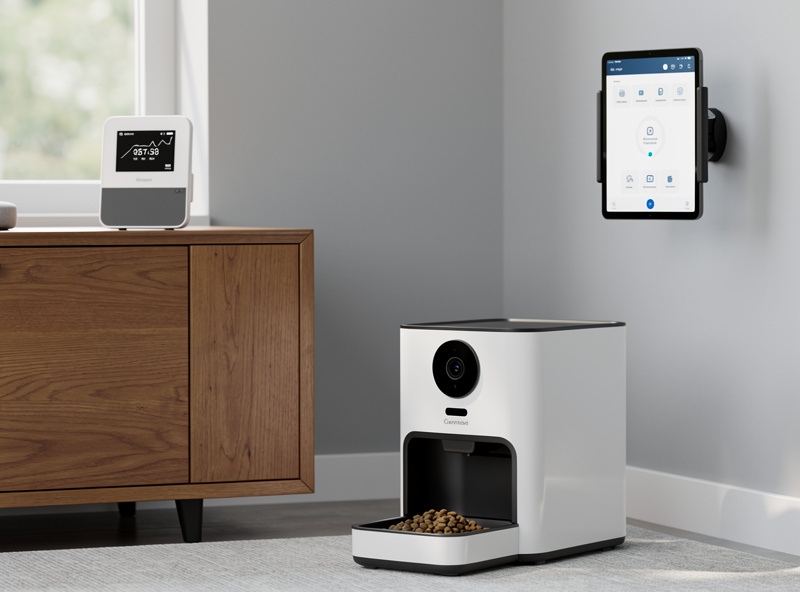
The best smart pet feeders with camera combine automated meal dispensing, HD video monitoring, and two-way audio to keep your pets fed and connected while you are away. The average US pet owner spends $500-700 annually on pet care, and smart feeders prevent costly obesity-related vet visits through precise portion control that reduces overfeeding by 15-25%.
The best smart pet feeders with camera include the Petlibro Granary Camera Feeder (best overall at $130 with 5-liter capacity and 1080p HD camera), WOpet 7L Smart Feeder (largest capacity at 7 liters, around $150), and Furbo 360 Dog Camera (best for dogs with treat tossing, around $210). These devices use auger or conveyor mechanisms to move dry kibble from storage hoppers into feeding bowls on programmable schedules.
Camera systems include wide-angle HD lenses with night vision, two-way audio with speakers and microphones, and motion detection that triggers automatic recording when pets approach. Cloud storage saves video clips of feeding events for review, while local SD card storage provides privacy-conscious alternatives. Advanced models feature AI-powered pet facial recognition for multi-pet households, health monitoring through consumption pattern tracking, and integration with veterinary telehealth platforms.
Setup involves gradual introduction while you are home, programming feeding schedules matching your pet current routine, and optimizing camera angles to capture the feeding bowl clearly. Most adult cats and dogs thrive on 2-3 meals daily, while puppies and kittens require more frequent feeding.
Smart Curtain Openers
Smart curtain openers automate your window treatments, opening and closing curtains on schedules, in response to sunlight, or through voice commands. They improve energy efficiency by managing solar heat gain (reducing AC costs by 10-15% in summer), enhance privacy and security through scheduled operation, and eliminate the daily chore of manually adjusting curtains.
The best automatic curtain openers include the SwitchBot Curtain 3 (best overall at $70-90 with solar panel option), Aqara Curtain Driver E1 (best for HomeKit at $80-100), and Zemismart Smart Curtain Motor (best for heavy curtains at $60-80). These devices attach to existing curtain rods or tracks without replacing your curtains, making them renter-friendly upgrades.
Installation takes 5-15 minutes per window with no tools required for most models. SwitchBot Curtain 3 clips onto existing rods and charges via built-in solar panel or USB-C. Aqara Curtain Driver E1 requires a Zigbee hub but offers the deepest HomeKit integration. Zemismart supports track curtains in addition to rod curtains, making it the most versatile option.
Smart curtain automation integrates with broader smart home ecosystems. Schedule curtains to open at sunrise for natural wake-up lighting, close at sunset for privacy, or respond to temperature sensors to block summer heat. Pair with wall-mounted tablets for one-touch scene control that adjusts curtains, lighting, and thermostat simultaneously.
Smart Sprinkler Controllers
Smart sprinkler controllers replace traditional irrigation timers with weather-aware, zone-specific watering systems that save 20-50% on outdoor water bills. Landscape irrigation accounts for nearly a third of all residential water use nationally per EPA WaterSense, and a substantial share of that is wasted through overwatering, watering during rain, or running broken sprinkler heads unnoticed.
The best smart sprinkler controllers include the Rachio 3 (best overall at $150-230 with EPA WaterSense certification), Orbit B-hyve (best budget at $80-120), and RainMachine Pro-16 (best for advanced users at $180-230 with local, cloud-independent processing — note the older HD-series RainMachine models have been discontinued). These devices connect to your existing sprinkler wiring and add WiFi connectivity, weather forecasting, and soil moisture integration.
Smart controllers use local weather data, hyperlocal forecasts, and evapotranspiration (ET) calculations to determine exactly how much water your lawn needs. They automatically skip watering before and after rain, adjust for seasonal changes, and provide detailed watering reports showing gallons used per zone. Many utilities offer rebates of $50-100 for EPA WaterSense-certified controllers like Rachio 3.
Installation takes 30-60 minutes and connects to your existing sprinkler system wiring. Most controllers support 8-16 zones, with expansion modules available for larger properties. Advanced features include freeze protection (preventing watering when temperatures drop below 35 degrees F), wind delay (skipping watering during high winds), and soil type customization for precise water delivery.
Choosing the Right Accessories for Your Home
Your accessory selection depends on your priorities and existing smart home setup:
| Priority | Best Accessory | Investment | Payback Period |
|---|---|---|---|
| Reduce energy bills | Electricity monitor + energy dashboard | $100-300 | 6-12 months |
| Save water bills | Smart sprinkler controller | $80-230 | 3-6 months |
| Pet care automation | Smart pet feeder with camera | $80-200 | Immediate (convenience) |
| Whole-home control | Wall-mounted tablet dashboard | $200-600 | Immediate (convenience) |
| Energy + privacy | Smart curtain openers | $70-90 per window | 12-18 months |
Smart Home Integration
These accessories integrate with broader smart home ecosystems to create automated routines that multiply their individual value:
Energy + Sprinkler Integration: When your electricity monitor detects high AC usage on hot days, your smart sprinkler controller can adjust watering schedules to early morning when evaporation is lowest, maximizing water efficiency during peak heat.
Tablet + Curtain Integration: Ythe wall-mounted tablet can trigger “Good Morning” scenes that open smart curtains, display weather forecasts, and show your energy dashboard all at once.
Pet + Security Integration: Ythe smart pet feeder camera can trigger smart motion sensor lights in the feeding area when your pet approaches at night, providing illumination for the camera while creating a welcoming environment.
Energy + Pet Integration: Monitor your pet feeder power consumption through your energy dashboard to detect motor issues before they cause missed meals. Unusual power draw patterns in pet devices often indicate mechanical problems requiring attention.
Installation Difficulty Comparison
| Accessory | Time Required | Tools Needed | Professional Help |
|---|---|---|---|
| Pet Feeder Camera | 10-15 minutes | None | Not needed |
| Curtain Opener | 5-15 minutes | None (most models) | Not needed |
| Sprinkler Controller | 30-60 minutes | Screwdriver | Optional |
| Wall Tablet Mount | 1-3 hours | Drill, level | For hardwired power |
| Energy Dashboard | 30-60 minutes | Screwdriver, wire strippers | Recommended |
| Electricity Monitor | 30-90 minutes | Screwdriver, wire strippers | Strongly recommended |
Cost-Benefit Analysis
Smart home accessories deliver measurable returns that justify their costs:
Electricity Monitor ROI: A $130 Emporia Vue saving 15% on a $150 monthly bill pays for itself in 6 months, then saves $270/year ongoing. Even modest 5% reductions ($7.50/month) pay back in 18 months. The visibility alone justifies the cost for most users.
Sprinkler Controller ROI: A $150 Rachio 3 saving 30% on a $60/month water bill during 6-month irrigation season saves $108/year. With utility rebates of $50-100, payback drops to 6-12 months. Over 5 years, total savings reach $540.
Pet Feeder ROI: A $130 Petlibro preventing one obesity-related vet visit ($200-500) pays for itself immediately. The convenience value of automated feeding during travel or long workdays is subjective but significant for pet owners.
Curtain Opener ROI: Smart curtains reducing AC costs by 10-15% save $15-30/month during cooling season. At $70-90 per window, a 3-window setup ($210-270) pays back in 7-18 months. Privacy and convenience benefits add ongoing value.
Wall Tablet ROI: A $400-600 tablet setup eliminates the need for multiple dedicated smart displays ($50-150 each) and provides centralized control that reduces the friction of managing a growing smart home. The convenience value compounds as your smart home expands.
Future of Smart Home Accessories
Smart home accessory technology continues advancing with exciting developments:
AI-Powered Energy Recommendations: Machine learning systems will suggest specific actions based on your consumption patterns — “Your refrigerator efficiency has declined 15% since last year; consider maintenance or replacement.”
Multi-Pet Recognition: Pet feeder cameras will use AI facial recognition to identify individual pets, dispensing customized portions and tracking each animal health metrics separately.
Grid Integration: Energy monitors will enable bidirectional communication with utilities for demand response participation, where your home automatically reduces consumption during grid stress events in exchange for bill credits.
Matter Protocol Support: The Matter smart home standard will bring cross-platform compatibility to accessories, allowing curtain openers, pet feeders, and energy monitors to work with Google Home, Alexa, and Apple HomeKit simultaneously.
Frequently Asked Questions
Which smart home accessory saves the most money?
Smart electricity monitors deliver the highest measurable savings, reducing energy bills by 10-30% through visibility and behavioral changes. A $130 Emporia Vue can save $270/year on a $150 monthly bill. Smart sprinkler controllers are second, saving 20-50% on outdoor water bills with 3-6 month payback periods.
Do smart home accessories work without internet?
Most accessories continue basic operation without internet. Pet feeders dispense pre-programmed meals, curtain openers follow local schedules, and electricity monitors record locally. However, you lose remote monitoring, app control, and weather-based adjustments until connectivity restores.
Can I install smart home accessories in a rental?
Yes. Pet feeders, curtain openers, and wall tablet mounts (surface-mount versions) require no permanent modifications. Smart sprinkler controllers replace existing timers with standard wiring connections. Electricity monitors that plug into utility meters need no panel work. Always check with your landlord before installation.
Which smart home ecosystem works best with these accessories?
Most accessories support multiple ecosystems. Curtain openers work with Alexa, Google Home, and Apple HomeKit. Energy monitors integrate with Home Assistant for power users. Pet feeders typically support Alexa and Google Home. For maximum compatibility, choose accessories that support the Matter protocol.
How do I choose between DIY and professional installation?
Pet feeders, curtain openers, and surface tablet mounts are easy DIY projects requiring no tools or minimal drilling. Sprinkler controllers need basic wiring skills. Electricity monitors require working inside electrical panels — strongly recommend professional installation unless you have electrical experience.
If I could only pick three accessories for my own house, I’d take the electricity monitor (the data alone changes how you think about energy), the smart curtain opener (the sunrise routine is the single best quality-of-life automation I’ve built), and the pet feeder (solved the 5 AM problem permanently). Buy accessories that solve a recurring friction you actually experience — not the ones that look impressive in a product video — and integrate them into your hub so they work together rather than living in separate apps.
Related Articles
- Best Smart Electricity Monitors for Home (2026)
- Smart Home Tablet Wall Mount: Dashboard Setup
- How to Set Up a Smart Home Energy Dashboard
- Best Smart Pet Feeders with Camera: Monitor Meals
- Best Automatic Curtain Opener 2026: Smart Curtain Motors
- Best Smart Sprinkler Controller 2026: Top Picks
- Best Smart Home Devices 2026: Top Picks
- Smart Home for Beginners: Complete Setup Guide
- Alexa vs Google Home: Which Should You Choose?
- Best Smart Motion Sensor Lights for Home Security