Home Security System for Renters: Best DIY Picks 2026
The best home security system for renters in 2026 is SimpliSafe — $250 base kit, peel-and-stick sensors that leave no damage, no contract, easily portable to your next apartment, and optional $20/month monitoring you can drop anytime. Ring Alarm at $200 is the runner-up if you already use Alexa devices. Both clear all four renter-specific requirements: no drilling, lease-friendly, sub-15-minute uninstall, and full functionality without modifying the unit.
As an Amazon Associate I earn from qualifying purchases.
Renters face four constraints homeowners do not: no drilling on doors or window frames (security deposit at risk), no permanent wiring, full reversibility when you move, and lease-clause compatibility (some leases restrict any “alarm system” installation). This guide covers what works within those constraints. For broader system context, see the smart home security systems hub.
The Four Renter-Specific Constraints
Renters need security gear that respects four boundaries professional installations do not consider. Get any of them wrong and you risk security deposit forfeit, lease violations, or simply hardware you cannot bring to your next apartment.
| Constraint | What It Means | Why It Matters |
|---|---|---|
| No drilling | Sensors must mount with adhesive only | Drilled holes risk security deposit forfeit at move-out |
| No permanent wiring | System must be plug-and-play | Hardwired panels require electrician work and landlord approval |
| Reversible install | Sub-15-minute removal with no residue | Must be portable to your next unit |
| Lease compatible | Adhesive-only, no exterior camera modifications | Some leases prohibit alarm systems or exterior fixtures |
Three of these constraints (drilling, wiring, exterior cameras) are why Vivint and ADT Pro are wrong for renters — both require professional install with drilling, and both lock you into a 42-60 month contract that survives an apartment move. The fourth (lease compatibility) is the under-discussed one — read your lease carefully before installing anything that could trigger a clause about “altering the unit.”
Best Picks for Renters
SimpliSafe — Best Overall for Renters
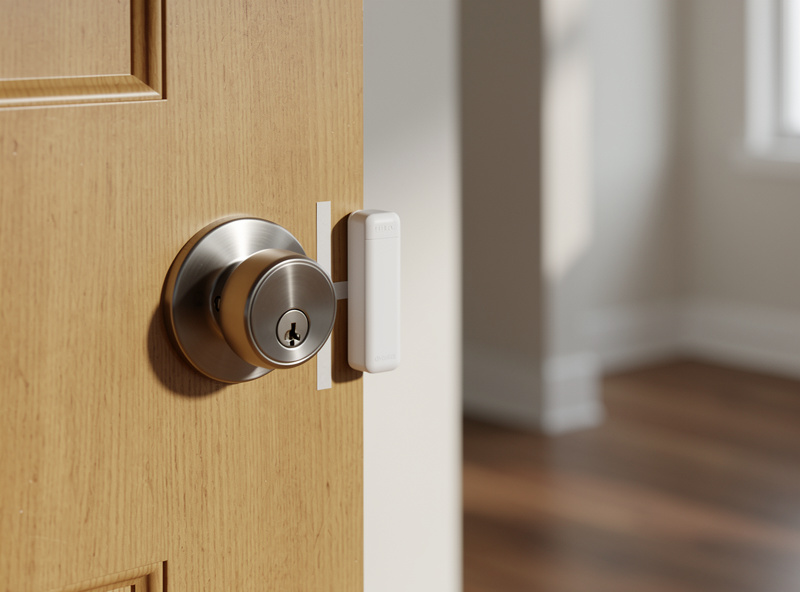
SimpliSafe ships with peel-and-stick door/window sensors and a wireless base station that plugs into any standard outlet. Total install time is 15 minutes; total uninstall (including removing adhesive without residue using a hairdryer to soften the glue) is also about 15 minutes. No contract means you can drop monitoring anytime — important for renters who move frequently. The base kit at $250 covers a 1-2 bedroom apartment; add 2-3 more door sensors for $30-$45 if needed.
Ring Alarm — Best for Existing Alexa Households
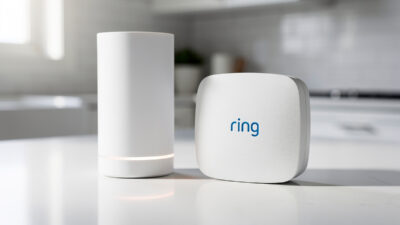
Ring Alarm follows the same DIY peel-and-stick pattern at $200 base kit. Ring Alarm’s edge for renters is integration with Ring video doorbells if you already own one — the doorbell often replaces a peephole without drilling, using the existing peephole mounting kit ($30 separate). For renter-friendly Ring camera options, see the Nest vs Ring doorbell guide and smart cameras without subscription guide.
Abode — Best for Smart Home Renters
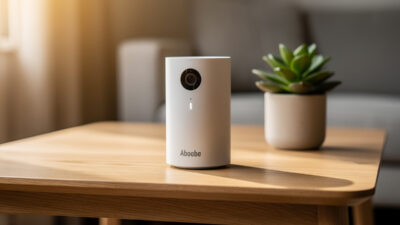
Abode is the right pick for renters running multi-protocol smart home setups. The Iota all-in-one at $280 includes a built-in 1080p camera, motion sensor, Z-Wave/Zigbee/Matter/HomeKit hub — everything in one device that plugs into any outlet. No drilling required, lease-friendly, and supports Apple HomeKit which neither SimpliSafe nor Ring Alarm do. For HomeKit renters, Abode is essentially the only option.
What to Skip as a Renter
Three categories of security gear are wrong for renters: hardwired alarm panels, drilled outdoor cameras, and any system requiring landlord approval for installation. The math is simple — you cannot afford to lose a security deposit over a $40 sensor mounting hole.
Hardwired Panels (Vivint, ADT Pro)
Both require an electrician and drilling for the SkyControl panel mount. Both lock you into 42-60 month contracts that follow you to the next apartment. ETF (early termination fee) on a Vivint contract canceled at month 24 typically runs $1,000-$1,400. Skip both — a renter version of any system in this guide costs less than the ETF you’d pay if you tried to leave Vivint mid-lease.
Drilled Outdoor Cameras
Wired-mounted outdoor cameras (Ring Spotlight Cam Wired, Vivint Outdoor Camera Pro) require drilling into the home’s exterior. Renters cannot install these without landlord approval, and most landlords will not approve. Battery-powered alternatives (Ring Spotlight Cam Battery, Eufy SoloCam) work fine without drilling — they mount with the included plate using picture-hanging strips or peel-and-stick mounts. For battery-powered cam options, the cameras without subscription guide is helpful.
Smart Locks Requiring Deadbolt Replacement
Most smart locks replace your existing deadbolt — fine for homeowners, problematic for renters. Two renter-friendly smart locks exist that retrofit over the existing deadbolt without removing it: Level Lock Plus (slim cylinder fits inside existing hardware) and August Smart Lock (mounts on the interior of existing deadbolt). Detail in the best smart locks guide, which has a renter-specific section.
Renter-Specific Install Tips
The right installation technique extends your security deposit lifespan by years. Three tips that the typical product instructions skip.
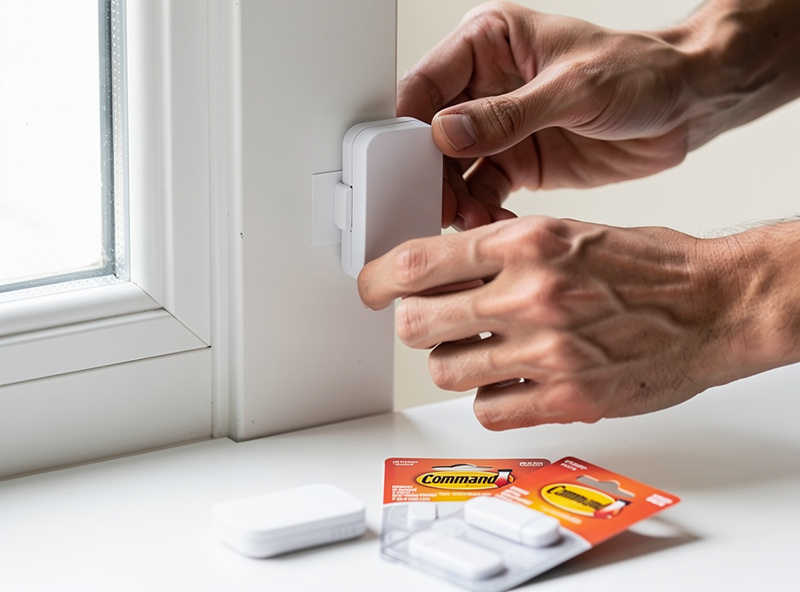
Use 3M Command Strips for All Adhesive Mounting
Even though SimpliSafe and Ring sensors come with their own adhesive, 3M Command Strips are far more removable. Buy a pack ($8 for 20 strips), peel off the factory adhesive, and apply Command Strips instead. When you move, Command Strips remove cleanly with no residue using the included pull tab. Factory adhesives often leave residue that requires Goo Gone and elbow grease — risking paint damage on rental walls.
Document Sensor Locations Before Installing
Take photos of every door frame, window frame, and wall before you stick anything. If a landlord later disputes damage at move-out, you have proof of pre-existing condition. This sounds paranoid but takes 5 minutes and has saved renters from contested deposit deductions repeatedly. Save the photos somewhere you’ll have access to in 2-3 years (cloud backup, not just your phone).
Mount the Base Station on a Bookshelf, Not a Wall
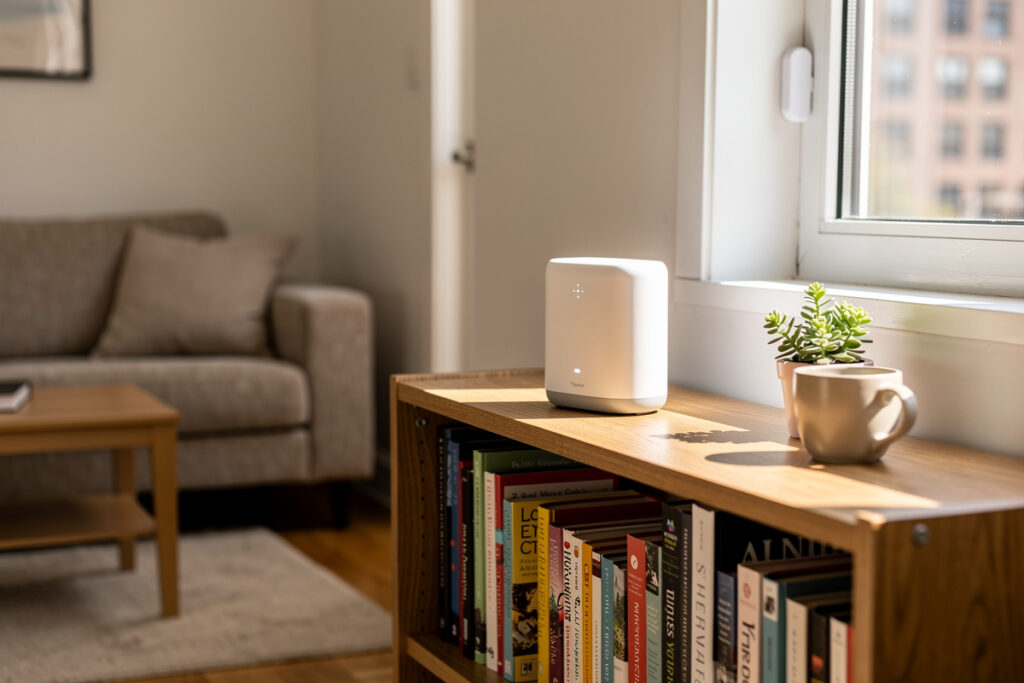
Most renters mount their base station on a wall using the included mount — drilling required. Don’t. Place it on a bookshelf or counter where it sits stably without mounting. The base station works perfectly without wall mounting, and you save the drill holes for things that matter more (TV mount, picture frames). Keep it elevated above floor level so the speaker projects properly during siren events.
Cellular Backup and Apartment Wi-Fi Considerations
Apartment Wi-Fi is more variable than single-family-home Wi-Fi — shared building networks, ISP changes between leases, and multi-unit interference. For renters, cellular backup matters more than for homeowners because Wi-Fi reliability is lower. The catch: cellular backup requires the paid monitoring tier on every major DIY system. So renters often face a trade-off between $0/month self-monitoring (with Wi-Fi-only reliability) and paid monitoring (cellular backup included).
The right play depends on your specific apartment. If your building has reliable fiber and you’ve never had outages, $0/month self-monitoring works fine. If your apartment Wi-Fi is unreliable or your ISP changes between leases, paid monitoring with cellular is the right choice — typically $20/month. The deeper trade-offs are in professional vs DIY monitoring. The $0/month detailed picks are in no monthly fee guide.
When You Move: Pack-Up Process
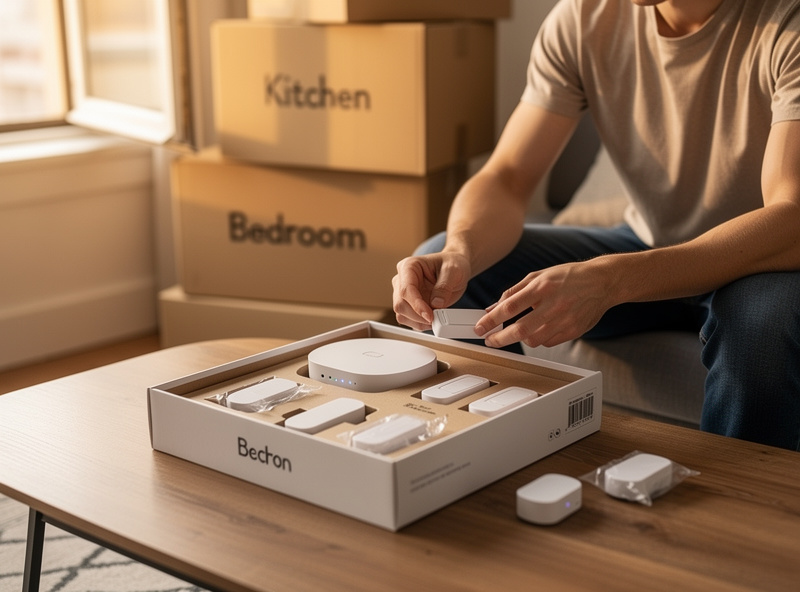
The moving process is where renter-friendly systems prove their value. SimpliSafe, Ring Alarm, and Abode all support relocation in under an hour. Open the app, mark the system as “moving,” peel sensors off (using a hairdryer if adhesive is stubborn), unplug the base station, pack everything in the original box, drive to the new apartment, plug it back in, and the system reconnects to your new Wi-Fi via the app.
Three things to handle in advance: update your address in the system app (especially important if you have monitoring — the central station needs to dispatch to the correct address), notify your monitoring provider 1-2 weeks before moving so cellular service follows you, and inspect every sensor location for adhesive residue before final walkthrough. Rinse Command Strip residue with warm soapy water; treat factory adhesive with Goo Gone if needed. Document final condition photos for the new lease.
Renters Insurance Discount
Renters insurance discounts for monitored security tend to run smaller than homeowners insurance discounts — carrier discounts for monitored systems generally range up to about 15%, and renters policies are cheap enough in absolute dollars that even a generous percentage rarely offsets a monitoring subscription. On a $250/year renters policy, even a 10% discount is $25/year — nowhere near offsetting $20/month monitoring. The math rarely justifies pro monitoring on insurance alone for renters; call your specific carrier for the real number before deciding.
Document the system with your carrier even if you self-monitor — some insurers offer 1-3% hardware-only discounts (no central station required). Call and ask: “What discounts do you offer for security systems and what proof do you require?” Get the answer in writing before deciding on monitoring tier.
Verdict for Renters
Pick SimpliSafe at $250 for the cleanest no-drill DIY install with widely-available support and the strongest no-contract reputation. Pick Ring Alarm at $200 if you already own Ring cameras or use Alexa heavily. Pick Abode at $280 for HomeKit-first households. All three handle the four renter constraints; the right choice within that group comes down to ecosystem fit, same as for homeowners.
Skip Vivint, ADT Pro, and any wired security system regardless of how good the marketing sounds — the contract math and install requirements actively work against you as a renter. For locks-specific guidance (which deserves its own decision), see the best smart locks guide.
Frequently Asked Questions
What is the best home security system for renters?
SimpliSafe at $250 is the best overall pick — peel-and-stick sensors, no drilling, no contract, portable when you move. Ring Alarm at $200 is the runner-up for households already using Alexa or Ring cameras. Abode at $280 wins for renters running Apple HomeKit smart homes. All three work without lease violations.
Can renters install a home security system without drilling?
Yes. Modern DIY security systems (SimpliSafe, Ring Alarm, Abode, Wyze) all use peel-and-stick adhesive sensors that mount on door and window frames without drilling. The base station plugs into a standard outlet. Total install with no drilling takes 10-15 minutes per system.
Will my landlord allow a smart security system?
Most landlords allow DIY systems with no drilling and no exterior modifications. Read your lease for any clauses about “altering the unit” or “alarm systems” before installing. Document the original condition with photos. Some leases prohibit cameras facing common areas (hallways, shared exterior) — be careful with outdoor camera placement.
How do I take a security system with me when I move?
DIY systems pack up in 10-15 minutes. Peel sensors off (use a hairdryer on stubborn adhesive), unplug the base station, mark the system as “moving” in the app, and pack everything in the original box. At the new apartment, plug the base station in and reconnect Wi-Fi via the app. Update your address with the monitoring provider if applicable.
Do renters need cellular backup on a security system?
Cellular backup matters more for renters than homeowners because apartment Wi-Fi is often less reliable. However, cellular usually requires the paid monitoring tier on every major DIY system. If your apartment has reliable Wi-Fi and power, $0/month self-monitoring works fine. If outages are common, paid monitoring with cellular ($20/month) is worth the cost.
Is professional monitoring worth it for renters?
Usually no. Renters insurance typically offers smaller monitoring discounts (5-10%) than homeowners insurance (15-20%), so the math rarely pencils out. Apartment buildings also have neighbors close enough to hear sirens, reducing the value of professional dispatch. Self-monitoring + a 100dB local siren covers most practical events for renters.
What about smart locks for rental apartments?
Most smart locks require replacing the deadbolt — problematic for renters. Two retrofit options work without lock replacement: Level Lock Plus (cylinder fits inside existing hardware) and August Smart Lock (mounts on the interior side of existing deadbolt). Both leave the original deadbolt intact and reverse cleanly at move-out.
Related Articles
- Smart Home Security Systems 2026: DIY vs Professional Monitoring
- SimpliSafe vs Ring Alarm: DIY System Comparison
- Home Security Systems With No Monthly Fee
- Professional vs DIY Home Security Monitoring
- Best Smart Locks for Renters — No Drilling Required