Smart Air Fryer Buyers Guide 2026: 4 Categories
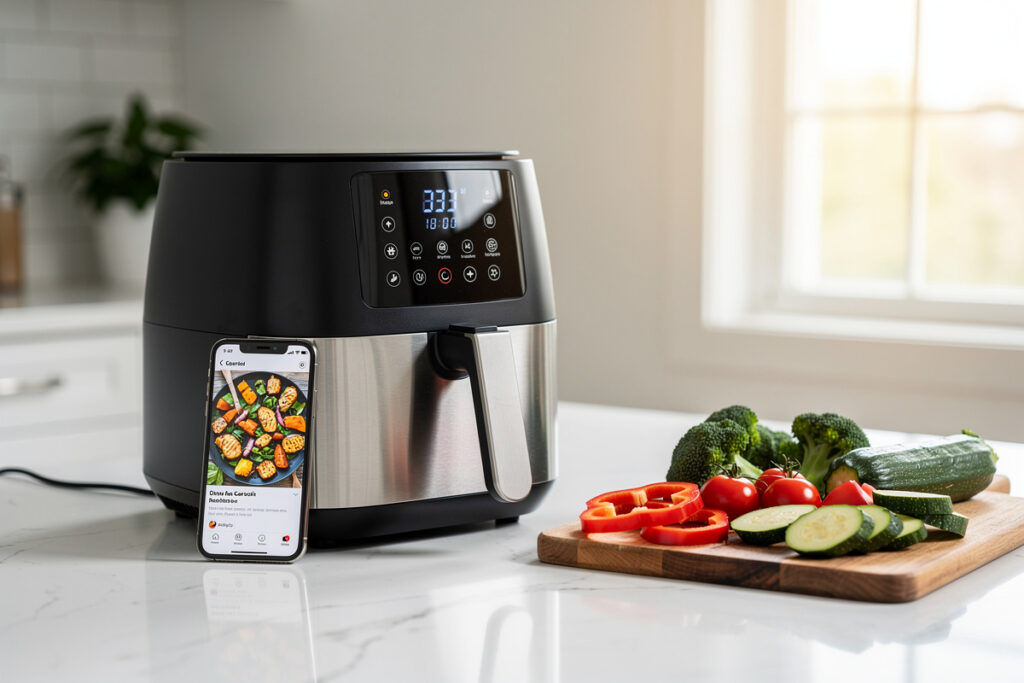
The smartest thing in my kitchen is not the air fryer itself — it is the energy-monitoring smart plug sitting behind it. When a cooking cycle ends, power draw drops from 1400 watts to under 2 watts, and Home Assistant fires a phone notification plus a 30-second repeating timer beep through the kitchen Echo Show. The air fryer did not need to be smart for that automation to work. It just needed a plug that reports wattage and a threshold rule. That setup — running daily in my kitchen for over a year — is the lens through which I evaluate the entire 2026 smart air fryer category, which spans $79 connected basics to $329 dual-zone units with Wi-Fi recipe libraries.
What follows is what living with that setup taught me about where a natively smart air fryer earns its place, where the smart plug outperforms the manufacturer app, and what actually matters when you are standing in a store aisle comparing a $49 dumb basket to a $229 connected dual-zone model.
The Power-Draw Trick: Why a Plug Beat the Manufacturer App
I put a smart plug with energy monitoring on my air fryer so Home Assistant could detect cycle completion without depending on the brand’s own push notification. The logic is simple: the air fryer draws roughly 1400 watts during active cooking, and when the cycle ends and the fan winds down, draw collapses to under 2 watts of standby. That drop is the trigger. HA fires a phone notification and a repeating kitchen timer through the Echo Show, and I stop checking whether the food is done.
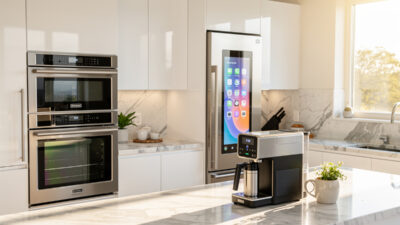
This is the same power-draw-as-a-proxy trick I use on the oven, the dishwasher, and the smart coffee maker, and it is a genuinely useful pattern for any dumb or semi-smart appliance that does not natively push a done notification. The appliance does not need to be smart at all — it just needs a monitoring plug behind it and a threshold rule in an automation. My air fryer’s own app already handles cycle-end natively, which makes the plug technically redundant. I keep it for the energy-cost visibility and because the local automation survives the app outages and firmware regressions that silently kill manufacturer push notifications — a failure mode that has happened to me more than once with connected kitchen gadgets, and that you only discover when the chicken is already burning.
One gotcha worth flagging if you replicate this: some air fryers draw power in a stepped pattern during preheat rather than a flat line. A naive “power dropped below threshold” trigger fires falsely during those brief mid-preheat pauses. I added a 15-second sustained-low-power condition before the automation fires, which filters out false triggers without meaningfully delaying the real notification. It is the kind of tweak that separates an automation you trust enough to stop checking manually from one you quietly abandon after the third false alarm.
What That Experiment Taught Me About the Category
Living with a smart-plug-monitored air fryer clarified where the manufacturer’s connected layer adds genuine value and where it is noise. The plug handles cycle-end detection and energy tracking better than any brand app — it is local, it survives cloud outages, and it works on any appliance, smart or dumb. What the plug cannot do is push a recipe program to the device. That is where a natively smart air fryer pulls ahead: tap “frozen wings” in the Cosori, Ninja, or Instant Brands app and the temperature, time, and shake-reminder schedule all push to the device automatically. No lookup, no “was it 400 or 380?”, no burnt-or-raw guesswork.
For households cooking 3-plus times per week, that recipe-push function alone justifies the $50-$80 premium over a comparable non-smart model by saving 1-3 minutes of lookup per session and eliminating the temperature-misremembering failure mode. For households pulling the air fryer out once a week or less, a $49 dumb basket plus a smart plug delivers the one automation that matters — cycle-end detection — for less total cost than a natively smart unit. The honest breakdown is that recipe push serves frequent cooks who would otherwise look up times and temperatures several times per week, while the plug-based cycle-end automation serves everyone regardless of cooking frequency, because nobody enjoys standing around waiting for a timer to expire.
Four Tiers by Capacity and Counter Footprint
| Category | Price Band | Capacity | Headline Connected Capability |
|---|---|---|---|
| Compact Smart | $79-$129 | 3-4 quart | Recipe push and cycle-end notification |
| Family-Size Smart | $129-$199 | 5-7 quart | Voice control and shake reminder |
| Dual-Zone Smart | $199-$249 | 9-10 quart (2 baskets) | Multi-zone synchronized finish |
| Air Fryer Toaster Oven Hybrid | $249-$329 | 10-12 quart | Bake, toast, broil plus interior camera |
Family-size and dual-zone cover the vast majority of weeknight cooking for 2-6 person households — chicken thighs, fish fillets, roasted vegetables, frozen items. Compact models suit 1-2 person households. The hybrid tier competes directly with smart countertop ovens and makes sense when counter space allows only one device.
The most common regret in smart air fryer owner forums is buying too small. It is much easier to grow into a bigger basket than to live with one that cannot fit a full weeknight meal for the household you actually have. The price gap between tiers is usually smaller than people expect going in, which makes sizing up the cheap insurance policy against the appliance getting relegated to the back of a cabinet after a few frustrating dinners where the basket simply could not hold enough food for everyone at the table.
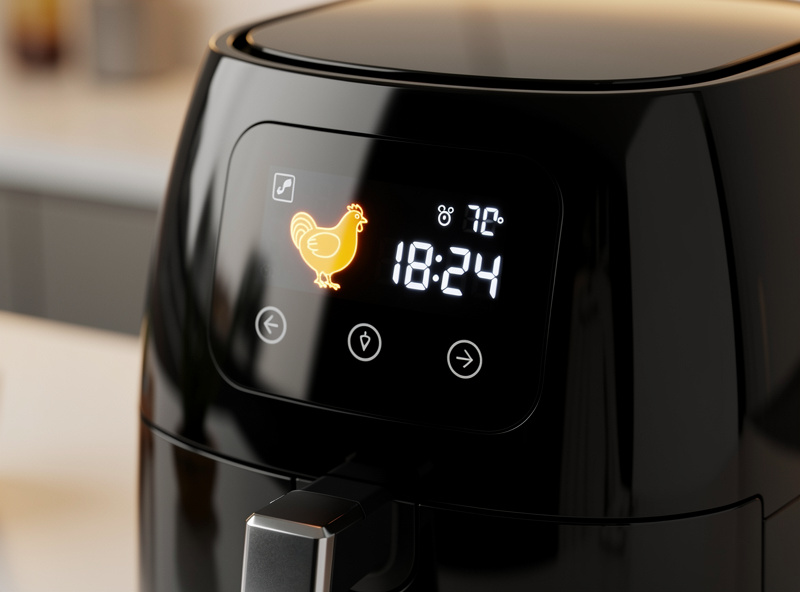
The Weeknight Loop: Recipe Push, Shake Alerts, and Synchronized Finish
Recipe push from app to device is the feature most owners cite as the daily difference-maker. Tap a recipe in the Cosori or Ninja app and the cooking program — temperature, time, shake-reminder schedule — pushes directly to the device. The lookup is eliminated. For frozen items where time and temperature are easy to misremember (frozen wings, fish sticks, mozzarella sticks), this single feature prevents the most common air-fryer failure mode: wrong temperature, wrong time, burnt food.
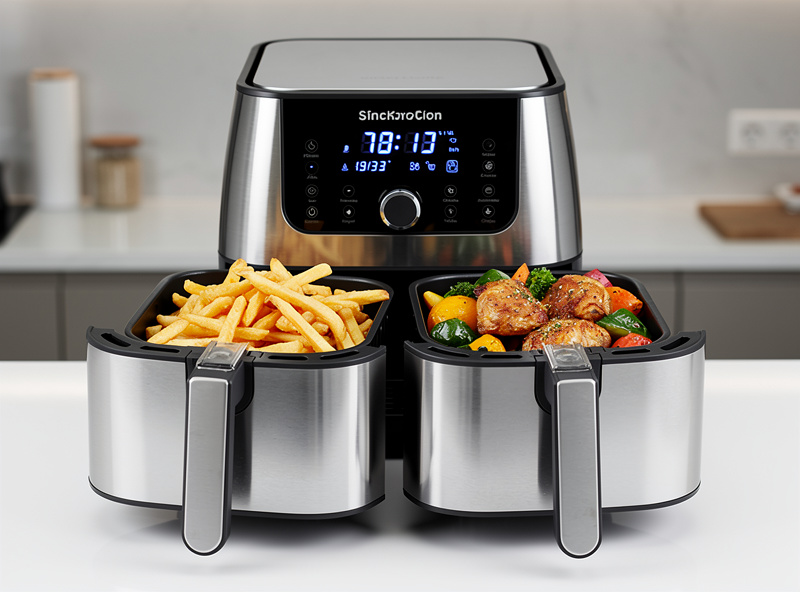
The dual-zone synchronized finish is the feature that changes weeknight dinner timing structurally rather than incrementally. The two baskets cook on independent programs but finish simultaneously: chicken in zone 1 at 45 minutes, broccoli in zone 2 at 8 minutes, both ready at the same moment. The app calculates the staggered start times automatically. For any household that has ever finished the sides while the protein goes cold waiting on the counter, this solves a real coordination problem that no single-basket model addresses.
Shake and flip reminders — a push at the 50% mark — address the easiest habit to forget and the one with the most visible payoff. Owners who consistently flip mid-cycle report noticeably more even browning than those who skip it. Cycle-end voice alerts (“Alexa, the chicken is done”) cover the gap between starting the fryer and dinner being ready, when you have moved to another room and lost track of the timer. Premium models add a wireless temperature probe for cook-to-temperature programs — chicken to 165°F internal regardless of cut size, eliminating the undercooked-or-overcooked variance that time-based cooking always carries when cut thickness varies.
Both Cosori and Ninja also host user-generated recipe communities inside their apps. These are useful for discovering new ways to use the device — air-fried chickpeas, reheated pizza, roasted vegetables — but they are not core to the weeknight loop. The pre-loaded brand recipes and the manual push function are what owners return to daily.
As an Amazon Associate I earn from qualifying purchases.
Cosori, Ninja, and the App-Reliability Divide
Cosori, Ninja, and Instant Brands dominate the 2026 smart air fryer category. All three support Alexa and Google Home with voice commands for start, stop, set timer, set temperature, and check status — the same voice-platform landscape covered in detail in the voice assistants and smart home protocols guide. Apple HomeKit support is limited to Cosori’s flagship Pro line as of Q1 2026; Ninja and Instant Brands skip HomeKit entirely. Matter has no defined air-fryer device type as of 2026 — it is one of the kitchen categories the Connectivity Standards Alliance’s Matter specification has not gotten to yet.
The app-reliability gap between the three brands matters more than any feature checklist. The Cosori app (VeSync) has shipped firmware updates every 60-90 days since 2022 and consistently rates above 4.4 on iOS and 4.3 on Android. Cosori’s recipe library ships with 500+ recipes. Ninja rates similarly on app stability and ships 300+ recipes. Instant Brands has a less consistent update cadence with 2 major degradation periods in the last 18 months and a smaller 200+ recipe library. The takeaway: browse the recipe library before purchase. If 50 recipes scroll by without anything appealing, the recipe-push function goes unused regardless of how many total recipes the library contains.
Off-brand smart air fryers — re-badged Shenzhen-OEM models on Amazon — often have no firmware update history at all, which means the connected features degrade as Wi-Fi standards evolve and the manufacturer never patches them. For a device you expect to run for 3-5 years, that matters. Sticking to Cosori, Ninja, or Instant Brands ensures at least a fighting chance of firmware support through the device’s lifespan.
For 2-4 person households, the Cosori Pro II at $129 covers the widest range of use cases with strong app reliability and a deep recipe library. For 4-6 person or batch-cooking households, the Ninja Foodi DualZone at $229 delivers synchronized two-basket finishing. Both carry Alexa and Google Home integration with ongoing firmware development behind them.
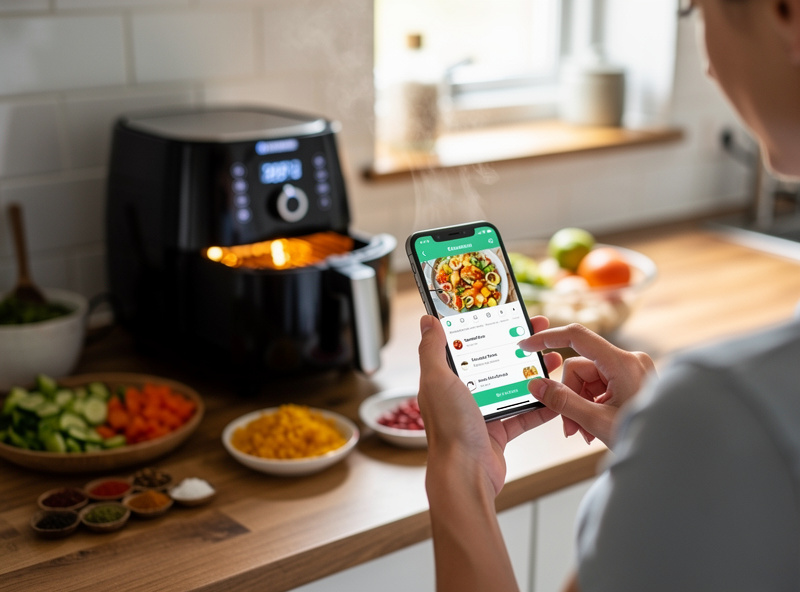
Sizing, Noise, Lifespan, and the Connectivity Floor
Capacity maps to household size: 3-4 quart for 1-2 people, 5-7 quart for 2-4, 9-10 quart dual-zone for 4-6 or batch cookers. Decibel output runs 60-72 dB during operation — premium models hit 60-65, budget models climb to 72-plus. Open-plan kitchens benefit from quieter models when the fryer runs during conversation or TV time.
Temperature range on most smart air fryers spans 100°F to 450°F. Premium models include temperature calibration; budget models often run 10-25°F off the displayed temperature. A $12 oven thermometer in the basket during the first month confirms accuracy and catches drift before it ruins a meal. All smart air fryers in 2026 ship with dishwasher-safe baskets. Premium models add removable interior racks for easier hand-washing; budget models often have non-removable racks that complicate scrubbing.
Smart air fryers from Cosori, Ninja, and Instant Brands typically last 3-5 years with daily use — the same lifespan as non-smart equivalents at the same price tier. The heating element and fan are the main wear points; the Wi-Fi module is rarely what fails. Energy use during cooking is roughly the same as a non-smart equivalent — about 1.4-1.7 kWh per typical session. The Wi-Fi module adds 1-3 watts of standby draw, less than $3 per year. The smart features do not save energy; the value is purely in cooking time, convenience, and the recipe-push lookup elimination.
If the internet drops, every smart air fryer continues cooking from the front-panel controls — you lose recipe push, voice commands, and push notifications, but the heating element and fan keep working normally. The cooking is unaffected; only the smart layer goes dormant until the connection returns.
Air Fryer or Countertop Oven: The Counter-Space Verdict
Smart air fryers and smart countertop ovens overlap heavily in 2026 product positioning. The air fryer wins on preheat speed (2-3 minutes versus 8-12 for a convection oven), counter footprint (about 60% smaller), and price ($79-$329 versus $249-$899). The smart oven wins on baking (true bottom heat), capacity (full Sunday roast), and multi-function flexibility (toast, broil, dehydrate).
For a 2-3 person household cooking weeknight dinners, the air fryer is usually the better single-device choice. For a 4+ person household or one that bakes regularly, the smart oven — or the hybrid air fryer toaster oven — earns its counter space. Counter footage is the practical constraint that resolves this more often than any feature comparison. If a wall oven already handles baking duty, the air fryer’s speed and footprint advantage wins outright, because you are not choosing between the two for baking — the wall oven already covers that. If the only oven is a countertop unit competing for the same square footage as the air fryer, the hybrid earns a much stronger look: it collapses two appliances’ worth of counter space into one, giving up a little raw air-fryer speed and the dual-zone synchronized finish in exchange for bake and broil functions the compact and family-size tiers simply do not have.
Many households end up with both an air fryer and an oven, splitting fast weeknight cooking from larger weekend cooking without deliberation. The deeper comparison lives in the smart oven buyers guide and the broader smart kitchen appliances guide.
Frequently Asked Questions
Which smart air fryer covers the most ground for a typical household?
For 2-4 person households, the Cosori Pro II (5.8-quart) at $129 covers the most use cases with strong app reliability and a 500-plus recipe library. For 4-6 person or batch-cooking households, the Ninja Foodi DualZone (9-10 quart, dual basket) at $229 delivers synchronized two-food finishing. Both carry Alexa and Google Home integration with ongoing firmware development behind them.
Is the premium over a $49 dumb air fryer justified?
For households cooking 3-plus times per week, the recipe-push feature alone saves 1-3 minutes per cook and eliminates the burnt-or-raw guesswork on frozen items. For households using an air fryer once a week or less, a $49 dumb basket plus a smart plug for cycle-end detection costs less total and covers the one automation that matters.
Can I control a smart air fryer with Alexa or Google Home?
Yes. Every smart air fryer from Cosori, Ninja, and Instant Brands supports both Alexa and Google Home with voice commands for start, stop, set timer, set temperature, and check status. Apple HomeKit support is limited to the Cosori Pro line as of Q1 2026; Ninja and Instant Brands skip HomeKit entirely.
Does a smart air fryer keep cooking if the internet drops?
Yes. Front-panel controls keep working without internet. You lose recipe push, voice commands, and push notifications, but the heating element and fan keep running normally. The cooking itself is unaffected; only the connected layer goes dormant until the connection returns.
How long do smart air fryers typically last?
Smart air fryers from Cosori, Ninja, and Instant Brands typically last 3-5 years with daily use, matching non-smart equivalents at the same price tier. The heating element and fan are the main wear points. The Wi-Fi module is rarely the failure point. Plan for dishwasher-safe basket replacement if the non-stick coating degrades.
Does the smart plug power-draw trick replace a natively smart air fryer?
No. A smart plug with energy monitoring can detect cycle completion and trigger a done-notification automation in Home Assistant, but it cannot push recipe programs (temperature, time, shake reminders) to the device. The plug handles cycle-end detection better than any brand app because it is local and survives cloud outages, but recipe push requires a natively smart air fryer.
Going Further
- Smart Kitchen Appliances 2026: Complete Buyers Guide (parent hub)
- Smart Oven Buyers Guide 2026: 4 Tiers Compared
- Smart Coffee Maker Buyers Guide 2026
- Best Smart Plugs 2026
- Voice Assistants & Smart Home Protocols Guide