Vivint Smart Home Security: Honest Review (2026)
Vivint Smart Home Security is the premium professional-install option in the residential security market — $599-$2,000 in equipment, $45-$60/month for monitoring, 42-60 month contract, and a technician who arrives on a specific day to install everything. The hardware is the best in the category, the app is the most polished, and the contract is the trade-off that disqualifies it for renters and short-term-stay buyers.
As an Amazon Associate I earn from qualifying purchases.
This review covers what Vivint actually delivers in 2026, where the contract math does and does not work out, and which households should pick it over the cheaper DIY systems compared in the smart home security systems hub.
Who Vivint Is Built For
Vivint is the right pick for homeowners who want a fully professional install, the most polished mobile app in the category, and high-end equipment without sourcing it themselves. It is not built for renters, short-term stays, or budget buyers — the contract length and monthly cost ($2,700-$3,600 over 60 months for monitoring alone) make it noticeably more expensive than DIY alternatives.
The classic Vivint customer is a homeowner with a 1,500-3,500 sq ft single-family home who wants the security system installed correctly the first time, has a strong preference for one company handling the entire setup, and values the integrated outdoor cameras with on-device AI (person, package, vehicle detection) that come with the higher-tier packages. If you read smart-home review sites and run a Home Assistant server, you are not the customer — Abode or SimpliSafe will fit better. If you want one app, one bill, and a technician’s phone number, Vivint is the answer.
What’s in a Vivint Package
| Component | Role | Notes |
|---|---|---|
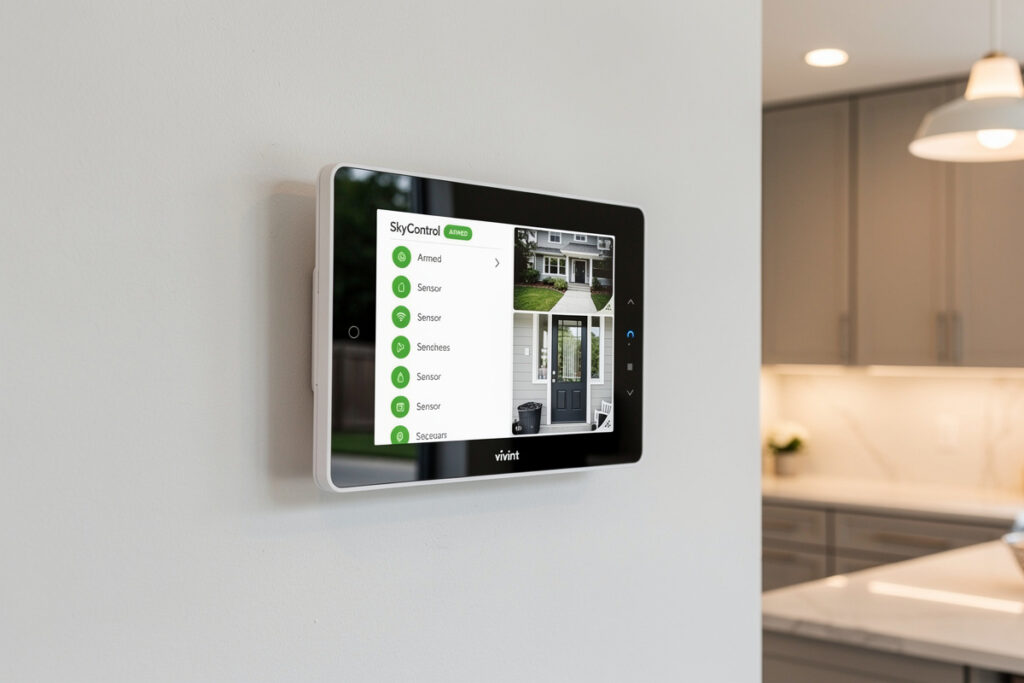
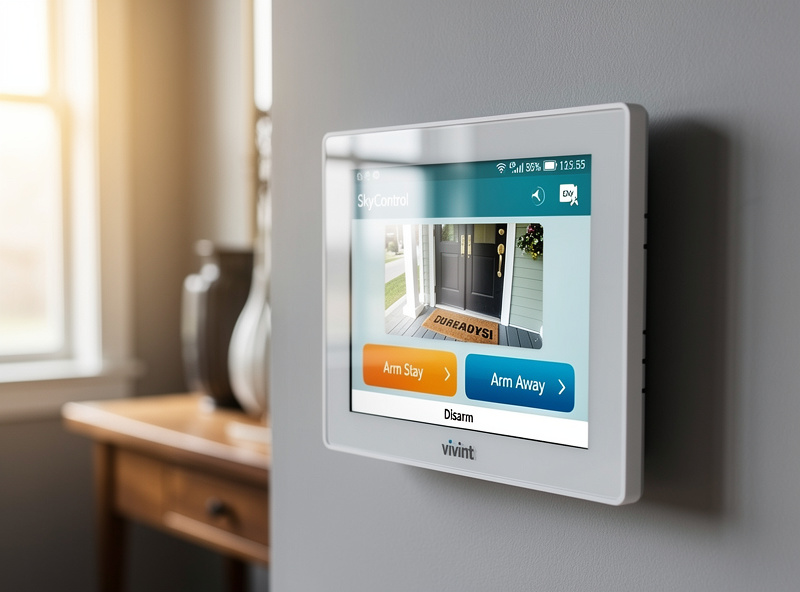
| SkyControl Panel | 7″ wall-mounted touchscreen, system brain | Includes built-in cellular and battery backup |
| Door/Window Sensors | Wireless contact sensors | Encrypted, 5-year battery |
| Motion Sensors | PIR with selectable pet immunity (35 or 55 lbs) | Avoids false alarms from cats and small dogs |
| Vivint Doorbell Camera Pro | 1080p HDR video doorbell with package detection | 180° field of view |
| Vivint Outdoor Camera Pro | 4K outdoor camera with on-device person/vehicle AI | Smart Sentry feature warns intruders verbally |
| Vivint Indoor Camera Pro | 1080p indoor camera with privacy shutter | Two-way audio |
| Smart Lock | Vivint Smart Lock or Kwikset Z-Wave | Auto-locks when system armed-away |
| Garage Door Controller | Liftmaster MyQ integration | Open/close from app |
| Smoke / CO Sensors | Life-safety monitoring | Qualifies for insurance discount |
| Water Leak Sensors | Z-Wave | Alerts on flood or pipe burst |
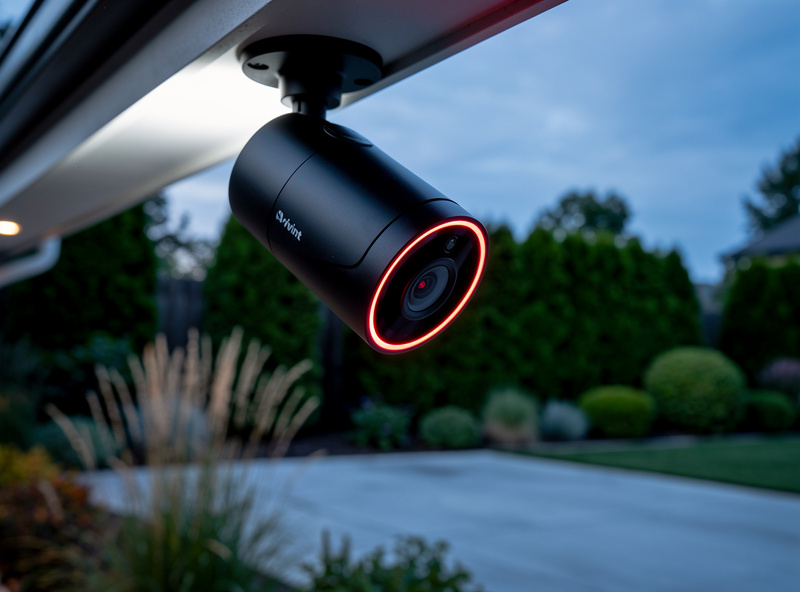
Three observations on this hardware list. First, the SkyControl Panel is the most polished alarm panel in the consumer market — bright touchscreen, fast response, clean UI. The DIY competition runs noticeably less responsive panels at all price points. Second, the camera lineup is the strongest competitive moat — Vivint Outdoor Camera Pro with on-device AI and Smart Sentry is genuinely useful — a bright red LED ring pulses twice before a crisp, authoritative voice warns “step back from the house,” and the 4K image holds sharp enough at 20 feet that you can read a license plate. This deters opportunistic prowlers more effectively than a recorded clip sent after the fact. Third, the Z-Wave hub is included in the SkyControl Panel, so third-party Z-Wave bulbs, locks, and thermostats integrate without a separate hub.
Contract and Cost Breakdown
Vivint contracts in 2026 typically run 42 or 60 months, with monitoring at $45/month for the basic Smart Security plan and $60/month for the Smart Home plan with cameras included. Equipment is purchased upfront ($599-$2,000) or financed over the contract term — financed equipment effectively raises the monthly payment to $80-$130. Total 5-year cost lands at $3,300-$5,200 depending on package and financing.
The contract math is the single biggest decision factor. Pay cash for equipment ($600-$2,000 upfront) and you save thousands over the contract. Finance equipment and you pay roughly equipment cost x 1.5 over 60 months in financing markup. Early termination fees on Vivint contracts equal the remaining balance — leaving the contract 24 months in on a 60-month plan typically costs $1,000-$1,400. Read the cancellation clause carefully. If you cannot commit to staying in the home for the full contract length, pick a no-contract DIY system from the security systems hub instead.
Monitoring Quality and Response Times
Vivint operates professional monitoring centers that follow UL 827 (Central Station Alarm Services) standards. Response times from alarm activation to dispatch depend on the verification process — the monitoring agent calls the premises to confirm before contacting emergency services. Two-way audio through the SkyControl Panel lets the agent verbally verify the alarm, which reduces false-alarm dispatches and the fines that some jurisdictions impose for repeated false alarms. Neither Vivint nor its competitors publish guaranteed second-count dispatch times; any specific numbers in marketing materials are best-case figures, not contractual guarantees.
Where Vivint genuinely outperforms: the Smart Sentry verbal warning system on the outdoor cameras detects loitering with on-device AI and triggers a recorded warning (“you have been detected and the property owners have been notified”) before any human dispatch. This stops most opportunistic prowlers without a 911 call. No DIY system replicates this with the same polish — Ring and Eufy have similar features but with noticeably less reliable detection. For the broader self-vs-pro monitoring decision framework, see the professional vs DIY home security monitoring guide.
App and Smart Home Integration
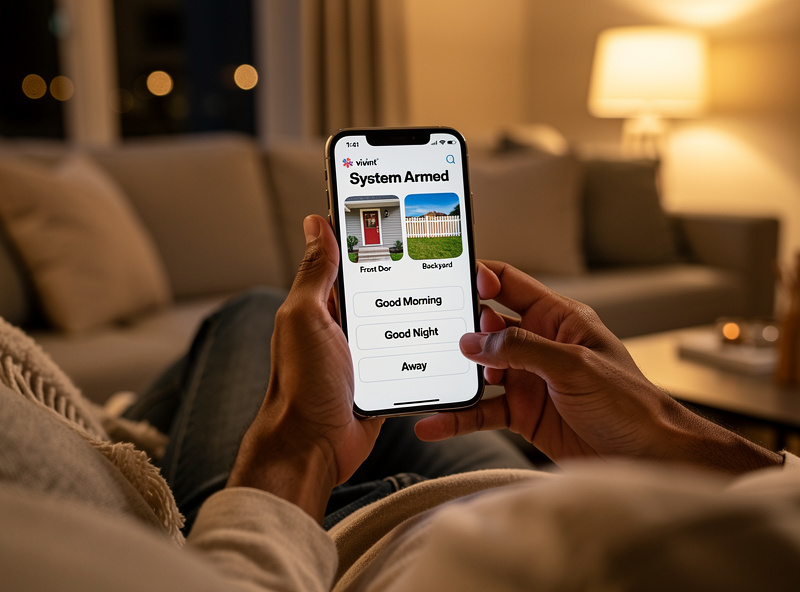
The Vivint app is the most polished in the category — fast, clean home screen with arm/disarm, live camera tiles, sensor status, and one-tap routines. Smart home integration covers Alexa and Google Assistant for voice control of arm/disarm and individual devices, plus Z-Wave compatibility for third-party lights, locks, and thermostats. Apple HomeKit and Matter support is missing in 2026 — a real limitation for HomeKit households.
In my own setup I would never run Vivint as the primary security layer — I need every sensor to report to Home Assistant, and Vivint’s closed ecosystem means the Z-Wave devices are locked to the SkyControl panel. If you have an iPhone and want HomeKit-native security, Vivint is the wrong choice — pick Abode instead. If you have Alexa or Google and want voice control plus a Z-Wave smart home, Vivint integrates well. The voice assistants do not handle the sensitive operations (no disarming via voice without a PIN, by design), but they handle most other commands cleanly. Compare ecosystem fit in the best smart home ecosystem comparison.
Vivint vs the DIY Alternatives
Versus SimpliSafe and Ring Alarm, Vivint costs roughly 2-3x more over 5 years, gets you noticeably better hardware and an included pro install, and locks you into a contract. Versus Abode, Vivint loses on smart home integration breadth (no HomeKit, no Matter) but wins on app polish and outdoor camera AI. Versus ADT Pro, the comparison is closest — Vivint app is better, ADT brand recognition is better with insurers, monitoring quality is comparable.
The honest framing: Vivint is buying convenience and hardware quality, and you pay roughly $2,000-$3,000 over 5 years for that convenience versus a DIY system. Whether that is worth it depends on whether you would actually have installed the DIY system correctly and whether your time is worth $40+/hour for the 4-6 hours an install takes. For most homeowners with stable housing and a strong preference for “have someone else handle it,” yes. For everyone else, no — the DIY alternatives are too good in 2026 to justify the contract premium. Direct DIY-vs-DIY comparison: SimpliSafe vs Ring Alarm.
The Vivint Install Experience
Vivint install is performed by a trained technician who arrives on a scheduled day with all the equipment in a marked van. Standard installs run 2-4 hours and cover panel mounting, sensor placement, camera installation (including outdoor camera drilling and weatherproofing), Wi-Fi setup, and a 30-minute walkthrough of the system. The install is included in the contract or charged at $99-$199 separately for cash buyers.
Quality of install is generally excellent — the technicians are W-2 employees, trained on a standard procedure, and insured. Where it can go sideways: technicians sometimes upsell during the visit (suggesting more cameras or sensors than your contract included), and once installed the equipment is not easily moved. If you sell the home, the system stays — Vivint can transfer the contract to the new owner or you keep paying. If you move, you can request a re-install at the new address (sometimes free, sometimes a $200-$400 service charge depending on contract). Worth confirming before signing.
Three Honest Limitations
Vivint has three limitations that come up consistently in reviews: long contract length (42-60 months versus zero on DIY alternatives), no Apple HomeKit or Matter support in 2026, and high cancellation fees if life circumstances change. None are deal-breakers for the right buyer; all three eliminate Vivint for renters, frequent movers, and HomeKit households.
I watched a neighbor try to cancel their Vivint contract 18 months into a 60-month term when they relocated for work — the early termination fee was the full remaining balance, nearly $2,600 plus equipment buyout. The contract is the most-cited downside. Vivint will sometimes negotiate down to 36 months for cash equipment buyers, but is unlikely to go shorter. The HomeKit/Matter gap is increasingly a problem as Matter adoption accelerates — Abode covers both, Vivint covers neither. The cancellation math is unforgiving: $1,000+ in early termination fees on a typical 60-month contract canceled at the 24-month mark. If your life is settled and you plan to stay 5+ years in the same home, these limitations do not apply to you. If anything is uncertain, the DIY systems are dramatically more flexible.
Verdict
Vivint is the right buy for settled homeowners who value pro install, app polish, and the best hardware in the category — and who are willing to accept a 42-60 month contract and $3,300-$5,200 5-year cost. It is the wrong buy for renters, frequent movers, HomeKit households, and budget-conscious buyers — for whom Abode, Ring Alarm, and SimpliSafe are dramatically better fits.
Frequently Asked Questions
Is Vivint smart home security worth it?
Vivint is worth it for settled homeowners who value pro install and app polish, accept a 42-60 month contract, and have $3,300-$5,200 5-year budget. It is not worth it for renters, frequent movers, HomeKit households, or budget buyers — Abode and SimpliSafe are better fits at less than half the long-term cost.
How much does Vivint cost per month?
Vivint monitoring runs $45/month for the Smart Security plan (basic) and $60/month for the Smart Home plan (includes cameras). Equipment is $599-$2,000 upfront or financed over the contract, raising effective monthly cost to $80-$130. Most homeowners pay between $50-$80/month all-in over a 60-month term.
Can I cancel a Vivint contract early?
Yes, but with significant fees. Early termination on Vivint contracts equals the remaining contract balance. Canceling 24 months into a 60-month plan typically costs $1,000-$1,400. Read the cancellation clause before signing — Vivint does not waive ETFs except in narrow exceptions like permanent military relocation or system non-functionality.
Does Vivint work with Apple HomeKit?
No. Vivint does not support Apple HomeKit or Matter as of 2026. The system integrates with Alexa and Google Assistant for voice arm/disarm and Z-Wave for third-party smart devices. HomeKit households should pick Abode instead, which natively supports HomeKit, Matter, Alexa, and Google.
Is Vivint better than ADT?
Vivint and ADT are the closest competitors. Vivint wins on app polish and outdoor camera AI (Smart Sentry verbal warnings). ADT wins on brand recognition with insurers (sometimes a slightly larger discount on homeowners insurance) and the Google Nest Hub Max integration after the Google partnership. Both have similar contract lengths, monitoring quality, and 5-year cost.
Can I install Vivint myself?
No, Vivint requires a professional installer. The technician arrives on a scheduled day for a 2-4 hour install. Self-install is not supported because the SkyControl Panel and outdoor cameras require professional placement and weatherproofing. If you want DIY installation, choose SimpliSafe, Ring Alarm, or Abode instead.
What happens to Vivint if I sell my house?
You have two options: transfer the contract to the new homeowner (Vivint requires their credit approval) or continue paying the contract yourself and reinstall at your new home. Reinstall fees range from free to $400 depending on contract terms. Read the moving clause before signing — it is one of the more variable terms.
Related Articles
- Smart Home Security Systems 2026: DIY vs Professional Monitoring
- SimpliSafe vs Ring Alarm: DIY System Comparison
- Professional vs DIY Home Security Monitoring
- Best Smart Security Cameras 2026
- Best Smart Locks 2026